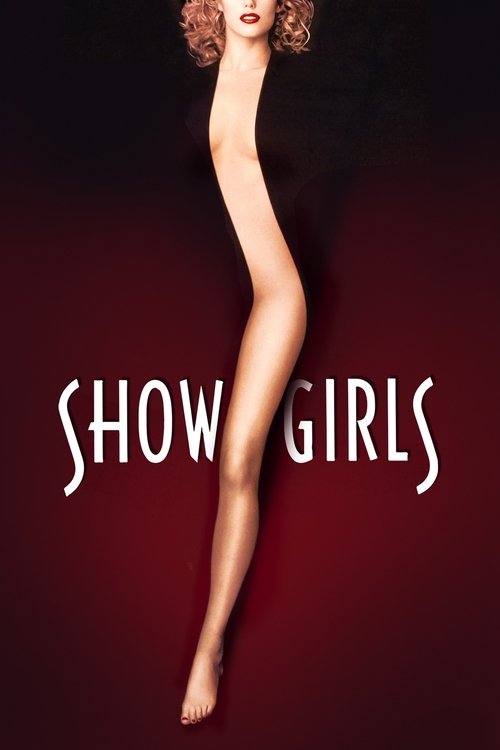
Showgirls
Plot
Fresh to Las Vegas with no connections, Nomi Malone takes a job as an exotic dancer. Her talents are quickly noticed by Cristal, a headlining dancer who senses an opportunity to bolster her own act. But Nomi won’t play second fiddle and soon begins her venomous path to the top, ruthlessly backstabbing anyone who gets in her way.
Get the Weekly Woke Watchlist
New and trending movies scored for woke bias, preachy messaging, and forced political themes — before you waste your evening.
No spam. One useful email per week.
Overall Series Review
Categorical Breakdown
The film utilizes race to signal morality in the narrative's social hierarchy, as the protagonist’s most gentle and sympathetic friends are the African American characters, Molly and James. In contrast, virtually all the white characters in positions of power, including the white female star, the producer, and the club owner, are depicted as corrupt, predatory, or emotionally abusive figures. The narrative does not lecture on systemic oppression, but it frames the dominant racial group as fundamentally toxic to the outsider protagonist.
The central theme of the movie is a scathing, hyperbolic assault on the 'American Dream' and key American institutions like the entertainment and casino industries. The narrative explicitly equates the ruthless pursuit of success and fame under capitalism with corruption and spiritual degradation, presenting the home culture of Las Vegas as a moral cesspool. This is not a respectful depiction of any part of the nation's heritage or institutions.
Gender dynamics are defined by a cutthroat, zero-sum competition for power and status in a male-dominated industry. The female protagonist, Nomi Malone, is an ambitious, self-made woman whose 'success' requires her to be violent and amoral, directly embracing a ruthless, individualistic form of 'Girl Boss' ambition. Men are almost universally portrayed as either 'misogynistic louts' or 'ridiculous,' reinforcing the idea that they are only capable of holding institutional power and acting as obstacles or abusers to the women.
The core plot is a heterosexually-coded rivalry over a man, but the major antagonist, Cristal Connors, is explicitly bisexual, and her sexual fluidity is shown as part of her manipulative power dynamic. Later cultural analysis identifies the protagonist’s fractured identity and the film's non-traditional portrayal of sexuality as an ambivalent form of 'queer subjectivity' that breaks with a heteronormative gaze. Sexuality is treated primarily as a tool for economic and social power rather than a private matter or a source of normative structure.
The movie does not overtly attack Christianity or other organized religion; there are no Christian characters depicted as villains or bigots. The focus is instead on a purely secular, amoral, capitalist system that offers no ethical framework, causing the 'corruption of the soul' in its pursuit of fame. Morality is shown as subjective and entirely secondary to the power dynamics and materialist ambition of the Las Vegas setting, embodying a transcendent moral vacuum.
Get the Weekly Woke Watchlist
New and trending movies scored for woke bias, preachy messaging, and forced political themes — before you waste your evening.
No spam. One useful email per week.