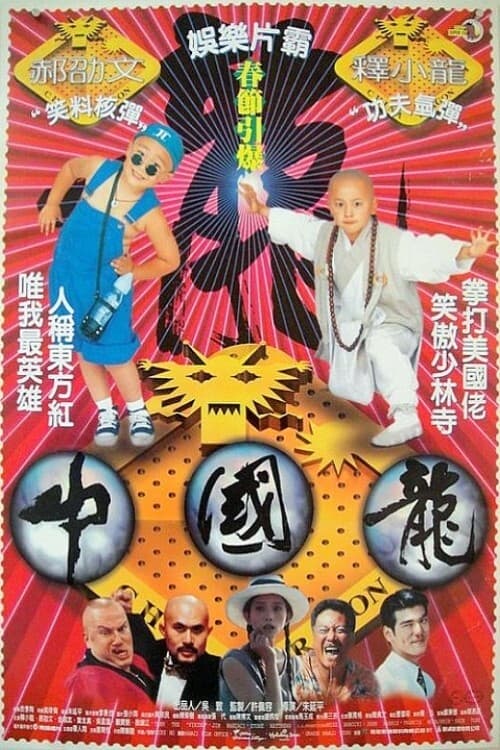
China Dragon
Plot
Two agile Hong Kong martial arts kids join up with a pair of bungling Chinese-immigrant beach bums on the sunny shores of Hawaii, where they divide their time between sophomoric kung-fu kid hijinks and their designated mission--tracking down a missing book whose secrets have fallen into the hands of a power-hungry villain.
Get the Weekly Woke Watchlist
New and trending movies scored for woke bias, preachy messaging, and forced political themes — before you waste your evening.
No spam. One useful email per week.
Overall Series Review
Categorical Breakdown
Characters are defined by their skill in Kung-Fu and their mission to protect a national treasure, which is a pure measure of character merit. The casting is entirely Asian, authentic to the film's origin and subject matter, and does not involve race-swapping or forced diversity. There is no narrative focus on intersectional hierarchy or vilification of 'whiteness'; the antagonists are an 'underworld figure' and an 'evil power monger' whose villainy is driven by greed, not systemic oppression.
The movie is a non-Western (Taiwanese/Hong Kong) production. The plot's entire premise is the defense and preservation of a 'national book of supernatural secrets' tied to the Chinese Shaolin Temple, demonstrating a protective attitude toward ancestral culture and heritage. The institutions being upheld—Shaolin and national security (a 'nuclear code key')—are viewed as positive forces against chaos. This demonstrates cultural affirmation, not civilizational self-hatred.
Yin, the female lead, is established as 'the best at Kung-Fu' and 'mastered supernatural powers,' making her a highly capable and effective action hero and co-equal to the male lead. This is a common trope in Chinese martial arts cinema (wuxia/kung-fu meritocracy) and reflects a celebration of female competence through martial prowess, which is a merit-based system. There is no overt messaging that emasculates the male characters, who are equally skilled, or any anti-natal or anti-family rhetoric, which keeps the score low.
The action-comedy plot, which revolves around martial arts and recovering a stolen artifact, contains no elements of modern sexual or gender ideology. There is no centering of alternative sexualities, no deconstruction of the nuclear family, and no lecturing on gender theory. Traditional male-female pairing is present only in the background genre tag of 'Romance' and is not a political focus.
The film explicitly features the Shaolin Temple, a major cultural and religious institution of Chinese Chan Buddhism, as the origin of the protagonists' strength and spiritual training. The plot involves a 'national book of supernatural secrets' and mentions the assistance received by the heroes as a 'God-send,' acknowledging a transcendent, spiritual power as a source of good. This is a positive incorporation of spiritual concepts and shows no hostility toward faith.
Get the Weekly Woke Watchlist
New and trending movies scored for woke bias, preachy messaging, and forced political themes — before you waste your evening.
No spam. One useful email per week.