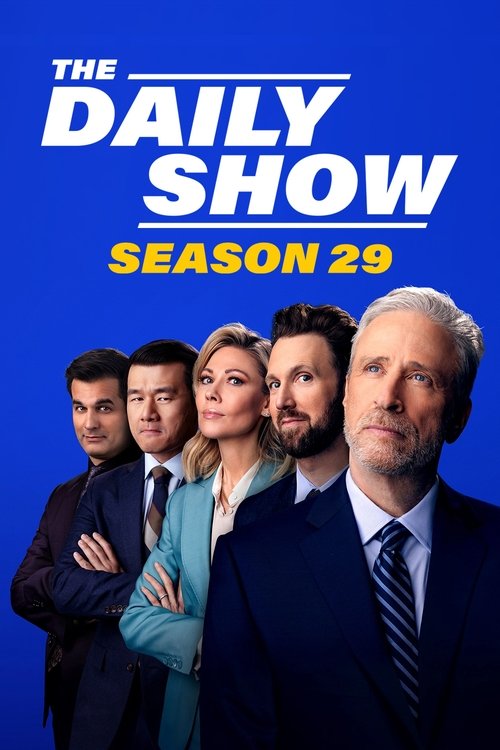
The Daily Show
Season 29 Analysis
Season Overview
Following the departure of host Trevor Noah at the end of 2022, a series of guest hosts from both within and outside "The Daily Show's" correspondents roster filled the program's anchor chair throughout 2023, each sitting in for a one-week assignment. On January 24, 2024, it was announced that Jon Stewart would return to the show he had hosted from 1999 to 2015. This time around, in addition to serving as an executive producer, Stewart will host Monday episodes through at least the end of the 2024 U.S. election cycle. From Tuesdays through Thursdays, members of "The Best F#@king News Team" will rotate hosting duties.
Season Review
Categorical Breakdown
The narrative and comedic material consistently apply an intersectional lens to political stories, framing issues through race, gender, and power dynamics. Characters and figures on the political right are routinely targeted as bigoted or xenophobic, and a segment specifically discusses the need to expand limited ideas of Black characters in media. One correspondent’s joke identifies the culture of getting people fired as an act white women have been doing for years, using racial identity to frame a behavioral critique. The show's diverse hosting and correspondent roster implicitly and explicitly elevates intersectional concerns over universal meritocracy.
Satire is primarily directed at the perceived fundamental corruption of the American political and media system, particularly when discussing election integrity, foreign policy, and domestic issues like gun control. The material routinely deconstructs political and institutional heritage through a critical, skeptical eye. This continuous emphasis on systemic failures and institutional decay frames the home culture as fundamentally flawed and in need of radical overhaul rather than preservation, scoring high on hostility toward existing institutions.
The show promotes a modern feminist perspective by dedicating segments to gender-focused issues such as the Alabama embryo law and the uncertainty of IVF, and it hosts a guest discussing a book that argues for abortion rights. Female hosts and correspondents like Desi Lydic are presented as authoritative and competent commentators who deliver sharp political critique. While male figures are frequently mocked, often their political incompetence is the primary target, rather than a universal emasculation trope, keeping the score from the maximum.
The show aligns with the political left on issues of sexual ideology. A segment satirizes conservative figures by suggesting their anti-gay rhetoric masks a 'secretly gay' identity, centering sexual orientation as a key element of political critique. The general editorial stance is one of acceptance and promotion of alternative sexualities and identities in the public sphere. The political defense of these issues and consistent pushback against traditional sexual/gender norms places it high on the Queer Theory Lens, though without extensive focus on gender ideology for children in the primary content.
The core of the show is secular political critique that rejects faith as a source of guiding moral law in public life. The content often satirizes policies driven by conservative religious morality, such as the Alabama IVF ruling, framing them as irrational or harmful. The overall moral framework is subjective and focused on political power dynamics rather than any acknowledgment of transcendent morality. Explicit 'villain' Christian characters are rare as the show targets real-world political figures, but the religious right is consistently framed as a source of political malice.