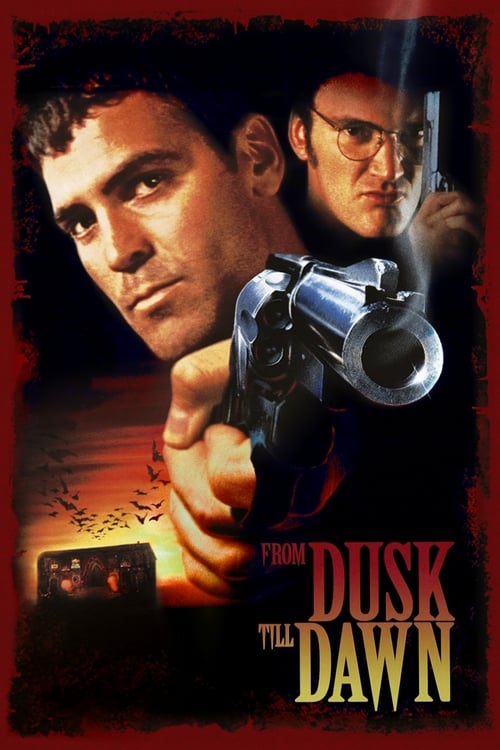
From Dusk Till Dawn
Plot
After kidnapping a father and his two kids, the Gecko brothers head south to a seedy Mexican bar to hide out in safety, unaware of its notorious vampire clientele.
Get the Weekly Woke Watchlist
New and trending movies scored for woke bias, preachy messaging, and forced political themes — before you waste your evening.
No spam. One useful email per week.
Overall Series Review
Categorical Breakdown
Characters are defined by their actions as criminals, victims, or survivors, not by race or immutable characteristics. The central villains are two violent white male bank robbers, but their villainy is personal and psychological, not a lecture on 'whiteness.' The multiracial group of survivors banding together is a result of circumstance and shared peril, not an intentional showcase of diversity for its own sake. Casting is natural to the settings without political framing.
The film does not portray Western culture as fundamentally corrupt or racist, but rather as one where criminals and violence naturally exist. The setting shifts from a standard American desert motel to a seedy Mexican bar, a 'den of evil' rooted in Mesoamerican vampiric mythology, which is framed as an ancient, non-Western terror, not a spiritually superior 'noble savage' archetype. The American institutions of faith and family, though flawed, provide the tools and motivation for survival.
The movie is an exploitation picture where women are primarily depicted as sexual objects (strippers) who are revealed to be monsters (vampires), and one of the initial hostages is raped and murdered by a villain. While this is anti-woman, it directly contradicts the 'Girl Boss' and 'Mary Sue' tropes. Female characters are not instantly perfect or shown to be inherently superior to men. The dynamics are crude, exploitative, and geared toward male fantasy and horror, which is antithetical to modern progressive feminist messaging.
The narrative follows a traditional heterosexual structure for all relationships, sexual situations, and characters. Sexual ideology is not a theme, and the primary focus on sexuality is highly crude and hyper-masculine (strip club, biker culture). There is no centering of alternative sexualities, deconstruction of the nuclear family beyond the existing hostage scenario, or lecturing on gender theory.
A main character is a former Christian pastor whose lack of faith is a key part of his initial weakness. Confrontation with supernatural, objective evil (vampires) directly results in him regaining his faith, which becomes a literal source of strength and a weapon (crosses, holy water) against the darkness. The film validates transcendent morality and the power of faith as an institution that provides defense against chaos.
Get the Weekly Woke Watchlist
New and trending movies scored for woke bias, preachy messaging, and forced political themes — before you waste your evening.
No spam. One useful email per week.