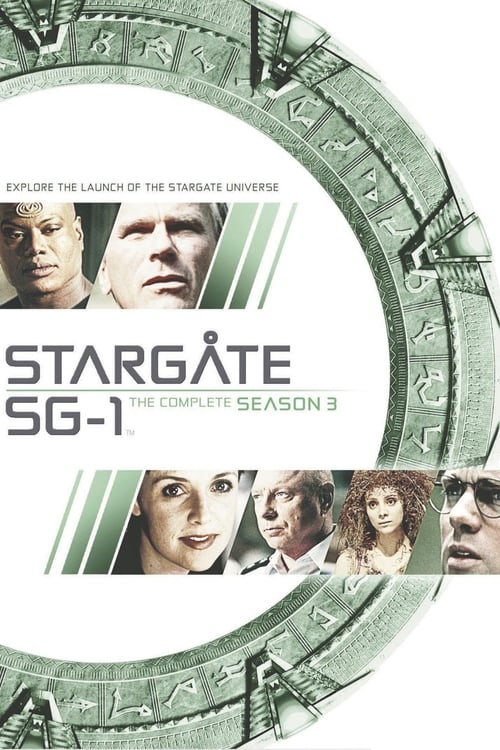
Stargate SG-1
Season 3 Analysis
Season Overview
SG-1 in their fight against the Goa'uld Empire's System Lords, the main being Sokar until "The Devil You Know" and then Apophis, after he regained power during that episode.
Season Review
Categorical Breakdown
The narrative operates entirely on meritocracy, with the multi-racial main team (two Caucasian males, one Caucasian female, one Black Jaffa male) judged solely on their skill and character. There is no vilification of 'whiteness' or exploration of intersectional hierarchy. Criticism is sometimes leveled at the casting for the planet-of-the-week cultures, such as the Orbanians, which were descended from a Meso-American civilization but portrayed by Caucasian actors, indicating a colorblind-to-a-fault approach rather than a politically motivated insertion of diversity.
The central premise is the protection of Earth and its institutions by the U.S. Air Force's Stargate Command (SGC), depicting the American military and scientific effort as the shield against chaos. The SGC is consistently the heroic, moral center trying to free enslaved humans from the Goa'uld. This highly positive framing of a powerful Western institution and a core defense of the home culture places the season at the lowest end of civilizational self-hatred.
Major Samantha Carter is a world-class scientist and military officer whose competence is constantly demonstrated on its own merits, but she is not presented as a perfect 'Mary Sue.' She is a leading figure, yet Colonel O'Neill and Dr. Jackson remain equally competent in their own fields. The gender dynamic is complementarian, with no significant emasculation of the male characters. The narrative focuses on her career fulfillment, fitting the 'Girl Boss' trope to a small degree, but without the corresponding message that motherhood is a 'prison.'
The season contains no explicit or implied LGBTQ+ themes, characters, or ideological discussions. The structure adheres to a normative presentation of human relationships, entirely avoiding the queer theory lens and any deconstruction of the nuclear family.
The core conflict of the series is rooted in the belief that all 'gods' are parasitic Goa'uld aliens using false religion to enslave humanity, which serves as a constant anti-theocratic message. In the episode "Demons," a world modeled on a medieval Christian community is shown to be easily manipulated into carrying out horrific acts by a Goa'uld-controlled demagogue, framing the faith as a tool for evil and mind control. This consistent pattern of religion as a vehicle for alien oppression and manipulation is a key deconstruction of faith as a source of strength, placing it higher on the anti-theism scale.