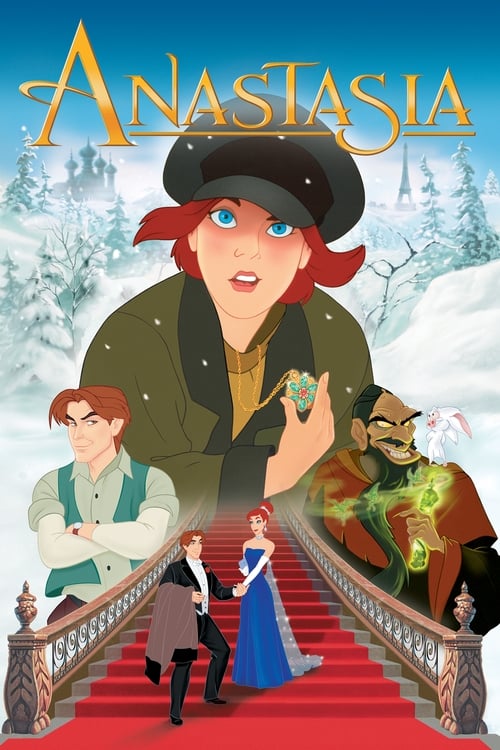
Anastasia
Plot
Ten years after she was separated from her family, an eighteen-year-old orphan with vague memories of the past sets out to Paris in hopes of reuniting with her grandmother. She is accompanied by two con men, who intend to pass her off as the Grand Duchess Anastasia to the Dowager Empress for a reward.
Get the Weekly Woke Watchlist
New and trending movies scored for woke bias, preachy messaging, and forced political themes — before you waste your evening.
No spam. One useful email per week.
Overall Series Review
Categorical Breakdown
Characters are all historically appropriate for the Russian and French setting, primarily of European descent. The narrative focuses on character merit, personal identity, and finding one's family, not an intersectional hierarchy or racial critique. There is no forced insertion of diversity or vilification of 'whiteness'; the antagonists are a spectral villain and con men, judged solely by their malicious intent. The casting is historically authentic to the European royalty and commoners of the era.
The film romanticizes the Russian Imperial aristocracy, portraying the opulent Romanov family as heroes whose survival is a triumphant end goal. The Russian Revolution, which overthrew the Tsarist regime, is not presented as a result of systemic oppression or working-class dissatisfaction but as the direct consequence of a magical curse from the villain, Rasputin, which avoids any real deconstruction of Russian heritage or Western civilization. The final choice is to pursue personal happiness in Europe over restoring the ancestral monarchy, which introduces a mild deconstruction of dynastic duty.
The protagonist, Anya, is highly competent, street-smart, and independent, claiming she learned to take care of herself while traveling alone across Russia. She is not a passive damsel; she is the one who single-handedly defeats the main villain in the third act while the male lead is incapacitated. The narrative prioritizes her individual choice and adventure (eloping) over the traditional expectation of assuming the throne and embracing dynastic duty or motherhood. This aligns with a moderate 'Girl Boss' trope, showing the woman's strength and agency superseding the man's protective role.
The narrative adheres entirely to a normative structure, focusing on the reunion of the traditional nuclear family (grandmother and granddaughter) and a traditional male-female romantic relationship between Anya and Dimitri. Sexual identity is not a plot point or character defining trait. There is no presence of alternative sexualities or gender ideology content within the story.
The central villain, Rasputin, is portrayed as an undead dark sorcerer whose power is derived from a mystical, evil green reliquary, not from any critique of the Russian Orthodox Church or Christianity itself. Faith is not a major plot element, but the Romanovs are not depicted as villains or bigots; the conflict is purely between good (family, love, memory) and supernatural evil. Traditional religion is sidestepped in favor of a fantasy villain, avoiding an explicit anti-theistic message.
Get the Weekly Woke Watchlist
New and trending movies scored for woke bias, preachy messaging, and forced political themes — before you waste your evening.
No spam. One useful email per week.