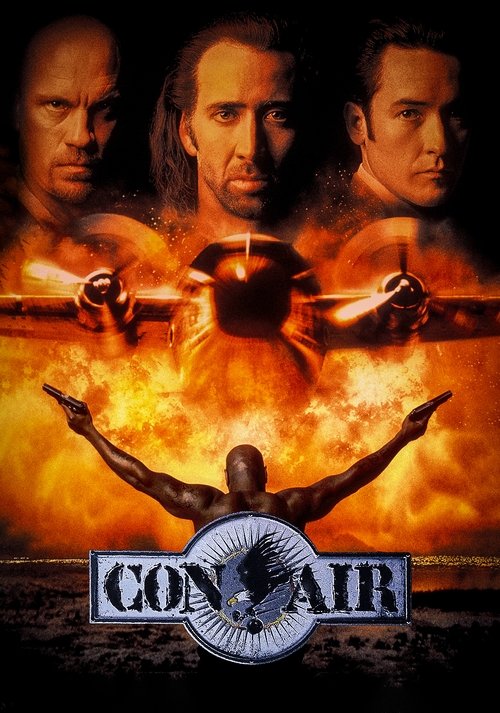
Con Air
Plot
Newly-paroled former US Army ranger Cameron Poe is headed back to his wife, but must fly home aboard a prison transport flight dubbed "Jailbird" taking the “worst of the worst” prisoners, a group described as “pure predators”, to a new super-prison. Poe faces impossible odds when the transport plane is skyjacked mid-flight by the most vicious criminals in the country led by the mastermind — genius serial killer Cyrus "The Virus" Grissom, and backed by black militant Diamond Dog and psychopath Billy Bedlam.
Get the Weekly Woke Watchlist
New and trending movies scored for woke bias, preachy messaging, and forced political themes — before you waste your evening.
No spam. One useful email per week.
Overall Series Review
Categorical Breakdown
The hero, an archetypal white Southern male, is the unwavering moral center, judged solely by his character and acts of sacrifice and protection. The villains are a diverse collection of depraved, 'pure predators' defined entirely by their extreme crimes and lack of humanity, not their race or identity. One key villain is a black militant terrorist who holds black supremacist views, but his ideology is clearly and completely framed as evil, making identity politics a component of villainy, not a celebrated virtue.
The protagonist's entire goal is to return home to his family and the life he built, with his love for his pregnant wife being the initial motivation for his manslaughter charge. The film champions the heroic Army Ranger as a man of principle who acts as a shield against chaos, viewing institutions like family and military service as sources of strength. The narrative displays gratitude for the hero’s willingness to make personal sacrifices to defend the innocent and restore order.
Gender roles are complementarian; the hero is the protective, vital male, having gone to prison for defending his pregnant wife from attack. His love for his daughter is the central driving force of the plot. The female corrections officer on the plane is immediately targeted by a serial rapist, establishing her as someone who requires the hero's protective masculinity, not as a 'Girl Boss' figure.
The film focuses entirely on the hero's traditional nuclear family structure: his wife and daughter. Sexuality remains private, and there is no attempt to center alternative sexualities or deconstruct the male-female pairing or gender biology. The environment is a normative, hyper-masculine setting that does not engage with queer theory or gender ideology.
The film establishes a clear, unwavering line between good and evil; the hero is good and the villains are pure sociopaths who represent chaos and moral depravity. The core conflict is a battle for a transcendent moral good (saving the hostages and the plane) against nihilistic, subjective evil. The film even includes multiple Christian references, indicating that faith is present as a possible source of strength or moral anchor, rather than being vilified.
Get the Weekly Woke Watchlist
New and trending movies scored for woke bias, preachy messaging, and forced political themes — before you waste your evening.
No spam. One useful email per week.