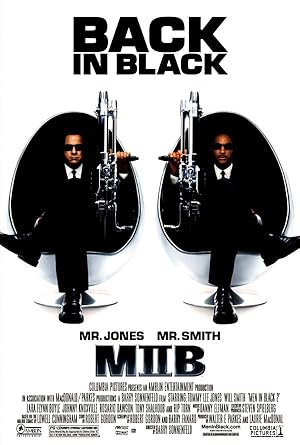
Men in Black II
Plot
Kay and Jay reunite to provide our best, last and only line of defense against a sinister seductress who levels the toughest challenge yet to the MIBs untarnished mission statement: protecting the earth from the scum of the universe. It's been four years since the alien-seeking agents averted an intergalactic disaster of epic proportions. And now it's a race against the clock as Jay must convince Kay-who not only has absolutely no memory of his time spent with the Men In Black, but is also the only living person left with the expertise to save the galaxy-to reunite with the MIB before the earth submits to ultimate destruction.
Get the Weekly Woke Watchlist
New and trending movies scored for woke bias, preachy messaging, and forced political themes — before you waste your evening.
No spam. One useful email per week.
Overall Series Review
Categorical Breakdown
The plot centers on a universal meritocracy where the competent, established Agent J, a black male, must rely on the institutional knowledge of his retired partner, Agent K, a white male. Character success is determined by MIB rank and extraterrestrial competence. Race, sex, or immutable human characteristics are entirely absent from the conflict, which is focused on intergalactic species politics.
The MIB organization exists solely to protect human civilization and Earth from external alien threats. The institution, while secretive, is explicitly framed as the necessary shield against chaos and universal destruction. There is no narrative element that suggests home culture, nation, or ancestors are fundamentally corrupt, racist, or deserving of deconstruction. Earth is the place the heroes fight to save.
The primary antagonist, Serleena, is a powerful, lethal female alien who is ultimately defeated and destroyed by the male lead characters. She is framed as a seductive but monstrous threat, not a 'Girl Boss' with moral superiority. The secondary female character, Laura Vasquez, is revealed to be a princess who must be protected and delivered home, a classical damsel/protection trope. Male-female dynamics are conventional, and no anti-natalist or anti-male messaging is present.
The core plot focuses entirely on intergalactic conflict, alien hiding, and the buddy-cop dynamic. Sexual or gender ideology is not a component of the story. Traditional male-female pairing and a normative structure are the accepted backdrop for human characters.
The movie includes a satirical subplot involving a miniature civilization living inside a locker who worships a watch and an old video rental card, creating a religion out of arbitrary human artifacts. This is a general satire of the origins of ancient belief systems and 'commandments' but avoids specific attacks on Christianity or traditional religion. The heroes fight for an objective good, which is the preservation of Earth.
Get the Weekly Woke Watchlist
New and trending movies scored for woke bias, preachy messaging, and forced political themes — before you waste your evening.
No spam. One useful email per week.