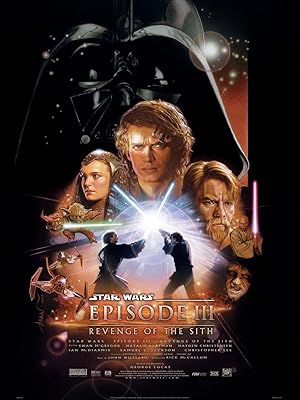
Star Wars: Episode III - Revenge of the Sith
Plot
Nearly three years have passed since the beginning of the Clone Wars. The Republic, with the help of the Jedi, take on Count Dooku and the Separatists. With a new threat rising, the Jedi Council sends Obi-Wan Kenobi and Anakin Skywalker to aid the captured Chancellor. Anakin feels he is ready to be promoted to Jedi Master. Obi-Wan is hunting down the Separatist General, Grievous. When Anakin has future visions of pain and suffering coming Padmé's way, he sees Master Yoda for counsel. When Darth Sidious executes Order 66, it destroys most of all the Jedi have built. Experience the birth of Darth Vader. Feel the betrayal that leads to hatred between two brothers. And witness the power of hope.
Get the Weekly Woke Watchlist
New and trending movies scored for woke bias, preachy messaging, and forced political themes — before you waste your evening.
No spam. One useful email per week.
Overall Series Review
Categorical Breakdown
Characters’ power and influence are based on their connection to the Force, political position, or combat skill, representing meritocracy within the narrative's own structure. The primary protagonist's downfall is entirely due to personal choices and emotional attachment, not external systemic oppression or a lecture on privilege. The casting is colorblind, with key roles like Mace Windu and Bail Organa filled by non-white actors without any focus on race or intersectional hierarchy in the dialogue or plot.
The central conflict is the tragic destruction of the Galactic Republic and the Jedi Order, which are framed as good institutions that were corrupted from within, not systems fundamentally evil from the start. The narrative treats the Republic's collapse into the Empire as an utter catastrophe. The Jedi are flawed in their dogma of detachment, which contributes to the tragedy, but they are clearly the heroes whose institutions are mourned, not vilified.
Padmé Amidala is a powerful Senator and leader throughout the prequels. However, in this film, her arc concludes with her giving birth and then dying because she has 'lost the will to live' after her husband's betrayal. This diminishes her from her previous 'Girl Boss' status and links her end to a purely emotional and natal role, which is explicitly anti-'Girl Boss' and a celebration of motherhood as the channel for the galaxy's future hope (Luke and Leia), though her own life ends in tragedy.
The story contains no presence of alternative sexualities, gender ideology, or deconstruction of the nuclear family. The nuclear family unit (Anakin, Padmé, and their unborn children) is in fact the catalyst for the entire tragic plot, with the hero's ultimate fall being driven by his secret, forbidden marriage and desire to save his pregnant wife. The narrative centers on the male-female pairing as the source of the next generation of heroes.
The Force provides an objective spiritual framework of good (Light Side) and evil (Dark Side). Palpatine, the ultimate villain, is the one who argues for moral relativism, stating 'Good is simply a point of view,' using this philosophy to corrupt Anakin. The Jedi Order, a monastic and quasi-religious institution, is portrayed as the flawed but moral opposition to the ultimate evil, thereby validating the existence of a higher, objective moral law.
Get the Weekly Woke Watchlist
New and trending movies scored for woke bias, preachy messaging, and forced political themes — before you waste your evening.
No spam. One useful email per week.