South Park
Season 10 Analysis
Season Overview
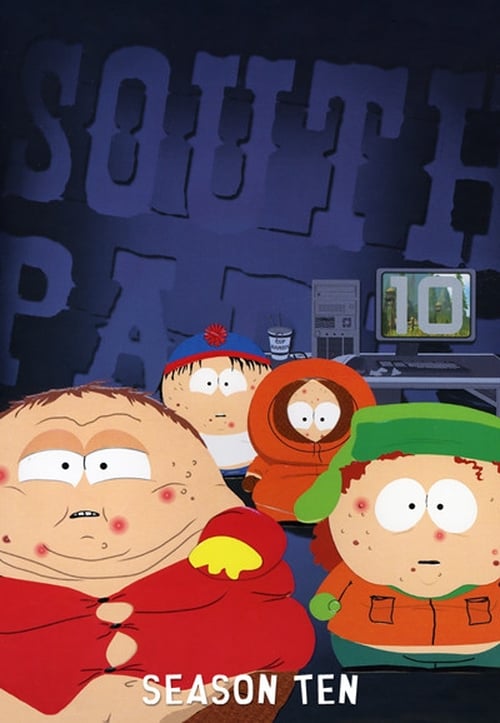
Join Stan, Kyle, Cartman and Kenny as they witness the death of Chef, defeat a virtual villain out to destroy the world, and suffer the consequences of Cartman’s video game console obsession. For them, it’s all part of growing up in South Park!
Season Review
Categorical Breakdown
Characters are vilified based on their individual greed, stupidity, or malice, such as Cartman's obsession with a video game or Al Gore's attention-seeking. The villain in the World of Warcraft episode is a rogue gamer, defined by his actions and not his race or identity group. The narrative maintains a focus on universal character merit and flaws. Race and immutable characteristics are not leveraged to grant moral authority or dictate the intersectional hierarchy of the plot.
The season satirizes modern American hypocrisy, such as the self-righteousness ('smugness') of liberal elites who drive hybrid cars in 'Smug Alert!' The critique targets specific cultural vices, not Western civilization or ancestral heritage itself. 'Cartoon Wars' champions the principle of free speech against censorship and fear, which aligns with traditional liberal Western values. Institutions like family and community are portrayed as dysfunctional but are not framed as fundamentally corrupt or evil.
Female characters are depicted with the same level of flaw and ridicule as the male characters. Liane Cartman is shown as an incompetent parent, not a marginalized victim, in 'Tsst!'. The teacher in 'Miss Teacher Bangs a Boy' is a statutory rapist and villain. There are no perfect 'Girl Boss' tropes, and female characters are complexly flawed, avoiding the emasculation of men as a primary plot device. Motherhood is satirized in the context of Cartman's over-indulgent mother, but the narrative is not broadly anti-family.
The season does not center alternative sexualities or gender ideology. Sexuality, when featured, is private or used for shock humor and adult satire, such as the teacher-student affair plot or the long-running character arc of Ms. Garrison, whose gender change is used for character comedy but is not the central ideological subject of her episodes this season. The narrative structure remains centered on the traditional lives of the four young boys, with no explicit lecturing on queer theory or deconstruction of biological reality.
The multi-episode story 'Go God Go' explicitly criticizes organized atheism, depicting a future where its various factions have created a warring, dogmatic 'Godless world.' This stance portrays dogmatism, whether religious or anti-religious, as the core problem. 'Cartoon Wars' critiques the cowardice of self-censorship in the face of religious threats, championing free expression. The show does not frame traditional religion as the root of all evil but satirizes the extremists and hypocrites within all belief systems, acknowledging a higher moral law (objective truth) that informs the critique.