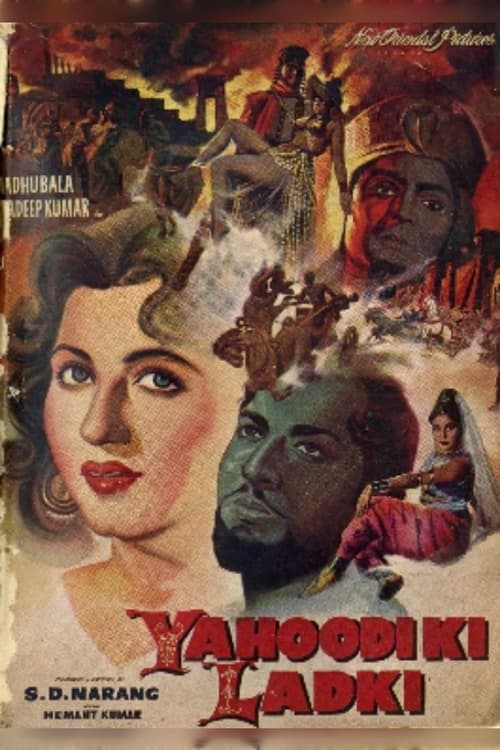
Yahoodi Ki Ladki
Plot
Yahoodi Ki Ladki (The Jew's Daughter) is a Hindi drama film directed by S.D. Narang, starring Madhubala and Pradeep Kumar as leads. The film became a silver jubilee hit on its release in January 1957.
Get the Weekly Woke Watchlist
New and trending movies scored for woke bias, preachy messaging, and forced political themes — before you waste your evening.
No spam. One useful email per week.
Overall Series Review
Categorical Breakdown
The plot's central conflict is rooted in a systemic oppression based on ethnic and religious group identity: the persecution of the Jewish Beni-Israelites by the tyrannical Pharaoh's regime. The narrative acknowledges group-based power dynamics, but the core theme is a struggle against ancient, non-Western tyranny. The protagonist from the oppressor group (Sajjad) is redeemed solely by his love for the heroine and his moral character, representing a universal meritocratic judgment.
The film is an Indian production set in ancient times and critiques the tyranny of a Pharaoh who declares himself a god. The narrative's hostility is directed purely at this oppressive, fictional ancient regime and not at the filmmakers' home culture, Western civilization, or ancestors. The film celebrates virtue and justice, which functions as a defense of civilized values rather than a critique of them.
The female lead, Farida, is central to the forbidden love story and the conflict, but her character arc is defined by faith, family ties, and her romantic relationship. The plot does not feature any 'Mary Sue' or 'Girl Boss' tropes, nor does it portray men as bumbling or toxic. The focus is on a traditional male-female pairing working to overcome external obstacles, reinforcing a complementary structure rather than anti-natalist or anti-male messaging.
The core of the film is a traditional male-female romantic relationship, which is the forbidden love between Farida and Sajjad. As a 1957 historical drama, the film operates entirely within a normative structure, centering the nuclear family and traditional pairing. There is no presence of alternative sexual ideologies, deconstruction of the family, or lecturing on gender theory.
The entire narrative is built around themes of religious conflict, faith, and the triumph of 'divine justice' and 'virtue over vice.' The main antagonist is a Pharaoh who explicitly 'declares himself a god and persecutes non-believers,' making the film a defense of true faith and transcendent morality against an evil, pseudo-divine, tyrannical force. Faith is a clear source of strength for the oppressed characters.
Get the Weekly Woke Watchlist
New and trending movies scored for woke bias, preachy messaging, and forced political themes — before you waste your evening.
No spam. One useful email per week.