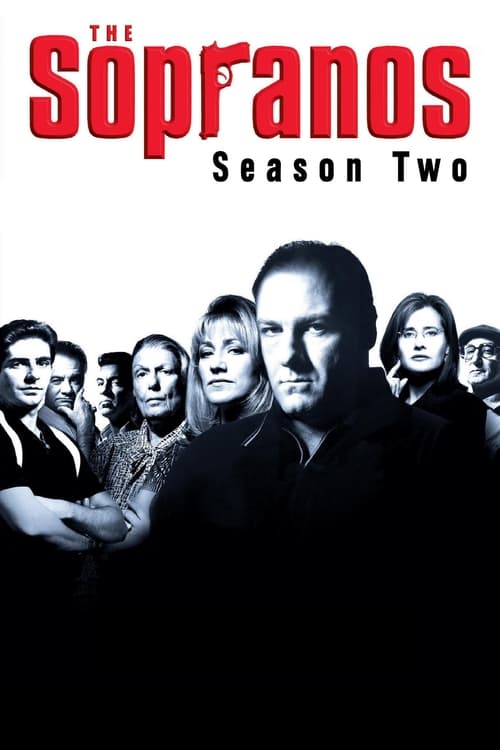
The Sopranos
Season 2 Analysis
Season Overview
His uncle's in jail. His mother's in the hospital. His best friend's still missing. His sister's moving home. His panic attacks are back. And his shrink refuses to see him. Tony Soprano has recently been elevated to the status of mob boss following a federal bust and as the second season picks up, Tony is under more stress than ever as he deals with the demands of his new position. Making matters worse, his long-lost sister Janice has arrived to take care of their ailing mother.
Season Review
Categorical Breakdown
The narrative does not center on race or an intersectional hierarchy. The primary drama is ethnic, focusing on Italian-Americans. Instances of race are used to demonstrate the main characters' personal, old-fashioned bigotry, such as when Tony uses slurs toward his daughter's boyfriend. The plot features the main characters violently shutting down a protest by black men at a construction site for purely financial gain, which shows the main 'white' characters as villains, but their motivation is economic self-interest, not a lecture on privilege.
The series constantly deconstructs the American family, the institution of the Catholic Church, and the entire mythology of the Italian-American mob heritage. The 'old school' lifestyle and the sacrifices of the ancestors are framed as a toxic, inherited pathology that haunts Tony. The show's critique is focused on the internal rot of this specific culture and criminal enterprise. There is no depiction of alien or 'Other' cultures as spiritually superior; the focus remains on the American self-hatred of the main characters' own corrupted way of life.
Gender dynamics are a central theme, with the female characters having significant psychological weight and narrative authority that continually challenges the male mob world. Dr. Melfi and Meadow provide moral and intellectual critique, while Carmela's traditional role is constantly portrayed as a gilded cage of misery and hypocrisy. Janice, in particular, is an independent character whose self-serving nature and anti-natal approach to life are directly contrasted with Carmela's motherhood, framing traditional female roles as restrictive. This suggests the emasculation of the male characters and a preference for non-traditional female archetypes.
The plot focuses entirely on normative male-female pairings, infidelity, and the hyper-masculine homosocial environment of the mob. There are no significant characters whose sexual identity is centered, and the narrative contains no plot points revolving around alternative sexualities, deconstruction of the nuclear family beyond the standard mob dysfunction, or lecturing on gender ideology.
Traditional religion is not portrayed as the root of evil, but its practice is depicted as shallow and hypocritical, particularly in Carmela's attempts to use Catholicism as a shield against her husband's life. The central search for meaning occurs entirely in the secular realm of psychotherapy with Dr. Melfi, suggesting that the characters have substituted a higher moral law for subjective psychological analysis. This reflects a 'Spiritual Vacuum' and an embrace of moral relativism in the modern age, but it stops short of active anti-theism.