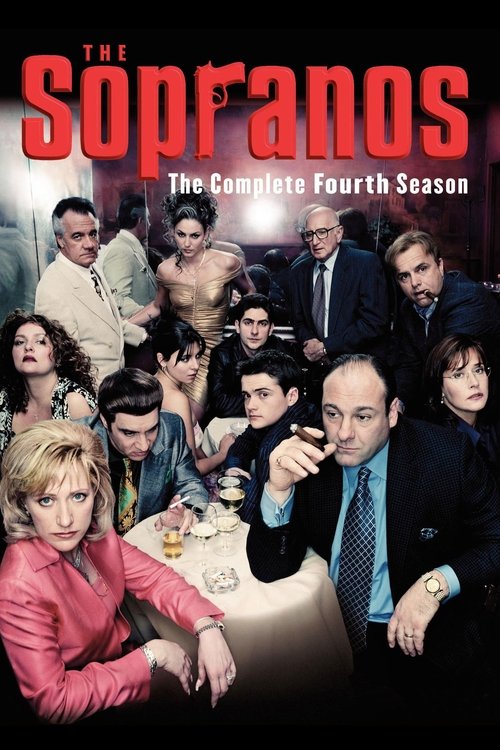
The Sopranos
Season 4 Analysis
Season Overview
With Paulie in jail, Christopher becomes acting capo in season four. Junior faces a RICO trial while Tony finds that the recession affects his businesses. Meanwhile, Furio catches Carmela's eye, and Janice sets her sights on Bobby.
Season Review
Categorical Breakdown
The episode 'Christopher' dedicates a significant portion of its plot to a direct conflict between the Italian-American crew, who defend Columbus Day as a symbol of their heritage, and Native American protesters who call it 'Indigenous People's Day.' This conflict is framed around clashing collective traumas, and is one of the show's most explicit engagements with intersectional identity and historical grievances. The crew's comments on real estate schemes in a predominantly Black neighborhood also highlight casual racism and the exploitation of race and class for profit. This shifts the narrative toward lecturing on systemic conflict for a single episode.
The central critique of the season is directed at the characters' individual immorality, hypocrisy, and the corruption of the mafia as an institution, which they treat as their 'home culture.' Silvio and other characters strongly defend their Italian-American heritage and the sacrifices of their ancestors, particularly during the Columbus Day dispute, showing a fierce pride that counteracts civilizational self-hatred. The show critiques the characters and their crimes, not the general Western framework or American culture itself.
The core domestic arc of the season involves Carmela's struggle for independence and self-fulfillment outside of her marriage to Tony, which she perceives as a financial and emotional prison. Her contemplation of divorce and pursuit of personal autonomy directly critiques the traditional mafia wife role and the toxicity of Tony's masculinity. Janice's storyline focuses on her seeking a relationship based on respect, explicitly rejecting the abusive male archetype. However, female characters are not portrayed as instantly perfect 'Girl Bosses,' and their struggles are painful, morally compromising, and complex, preventing a top-tier score.
Alternative sexualities are a non-factor in the main narrative of the season. A minor subplot involves a character incorrectly assuming an FBI agent is a lesbian because she rejects his advances, which is played for a moment of character-driven ignorance, not to center sexual ideology. The deconstruction of the nuclear family occurs through the traditional, heterosexual conflict of divorce, adultery, and moral failing, not through gender theory or queer theory.
Religion, specifically Catholicism, functions primarily as a source of guilt, hypocrisy, and a constant, visible reminder of the characters' moral failures. Carmela's central moral conflict involves her attempt to reconcile her material gain from blood money with her spiritual salvation, often seeking counsel from a priest. The narrative acknowledges a clear, objective moral law that the characters continually violate, suggesting a transcendent morality exists and is being ignored, rather than religion being the root of evil or morality being purely subjective.