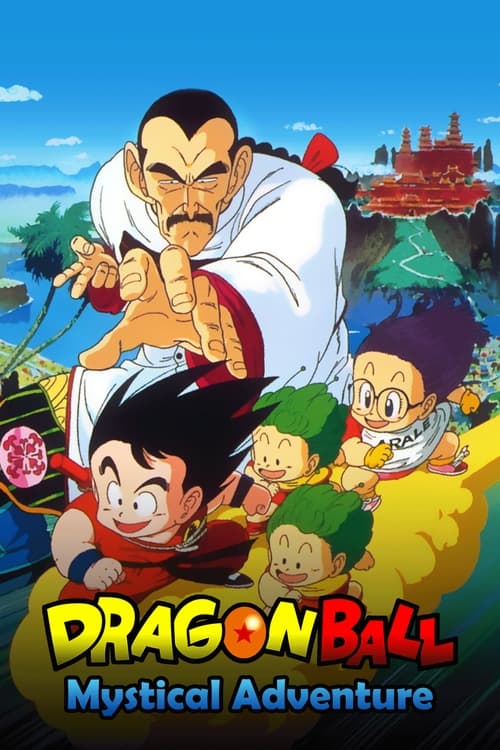
Dragon Ball: Mystical Adventure
Plot
Master Roshi has succeeded at the one mission he valued most: to train Goku and Krillin to become ultimate fighters. So, he arranges for them to test their mettle at a competition hosted by Emperor Chiaotzu. Not everyone's playing by the rules, however, as a member of the ruler's household schemes to use the Dragonballs to extort money and power from the royal.
Get the Weekly Woke Watchlist
New and trending movies scored for woke bias, preachy messaging, and forced political themes — before you waste your evening.
No spam. One useful email per week.
Overall Series Review
Categorical Breakdown
The film’s focus is on universal meritocracy; characters like Goku and Krillin are judged purely on their fighting strength and moral character. The conflict involves treachery and ambition (Master Shen’s coup) versus virtue and strength (Goku and his friends), with no element of race, immutable characteristics, or intersectional hierarchy driving the plot or character motivations.
The narrative centers on defending the fictional East Asian-inspired kingdom of Mifan from internal corruption. Institutions like the martial arts tournament and the kingdom itself are viewed as positive structures that must be protected from an individual villain. There is no framing of the home culture or ancestral values as fundamentally corrupt.
The main plot is male-dominated, centered on Goku and Krillin’s martial arts journey. Female characters like Bulma and Launch are present and capable, but their roles do not take center stage and are often secondary to the male protagonists' quest. There is no overt anti-natalist messaging, but the movie focuses on adventure and fighting rather than celebrating motherhood or complementary roles.
The story is a martial arts adventure and quest for magical artifacts. The film contains no discussion, centering, or lecturing on alternative sexualities, gender ideology, or the deconstruction of the nuclear family. Traditional male-female dynamics are the standard, aligning with a normative structure.
The movie operates within a fantasy world where mystical objects (Dragon Balls) and spiritual/physical training (martial arts) are the sources of power and guidance. The moral code is strictly objective (good vs. evil). This upholds the principle of transcendent morality and a higher moral law, even if the source is mystical rather than explicitly religious.
Get the Weekly Woke Watchlist
New and trending movies scored for woke bias, preachy messaging, and forced political themes — before you waste your evening.
No spam. One useful email per week.