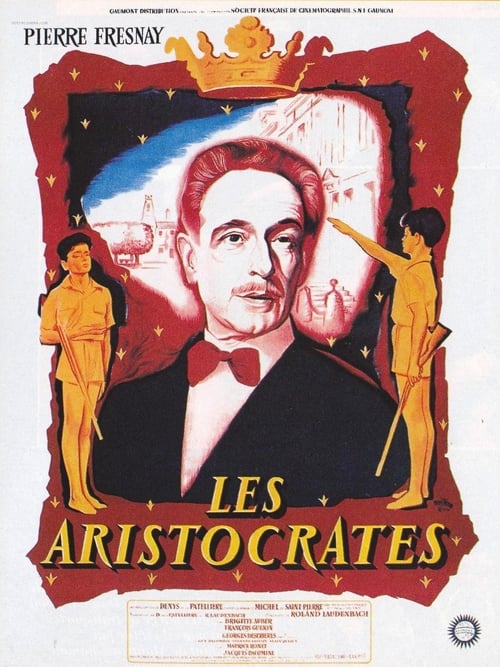
The Aristocrats
Plot
A novel by Michel De Saint Pierre was the source for Les Aristocrates. Pierre Fresnay stars an aging Marquis, who tries his best to uphold the traditions of nobility in an ever-changing world. The Marquis' children prefer the trappings of modern society and pop culture and regard their father as a relic. This cultural clash nearly results in tragedy when two of the Marquis' offspring substitute recklessness for common sense.
Get the Weekly Woke Watchlist
New and trending movies scored for woke bias, preachy messaging, and forced political themes — before you waste your evening.
No spam. One useful email per week.
Overall Series Review
Categorical Breakdown
The film’s central conflict is exclusively class-based and generational, pitting the old French aristocracy against the rising bourgeoisie and modern capitalism. All main characters are cast as white individuals authentic to their historical and cultural milieu. Character judgment rests on the clash between abstract aristocratic 'honor and duty' versus modern 'money and happiness,' a universal merit-based conflict in a changing society. The narrative does not employ an intersectional lens.
The narrative details the struggle of the Marquis to maintain an outdated system, acknowledging that the aristocratic way of life is 'out of breath' and requires 'new blood.' This constitutes a critique of a specific class and its decaying traditions within Western civilization, not a wholesale demonization of Western ancestors or a framing of the French home culture as fundamentally corrupt/racist. The conflict is internal, with the protagonist attempting to defend, not destroy, his cultural heritage.
The female characters, specifically the Marquis’s daughter Daisy, are focused on choosing their own marriage partner based on love and happiness rather than aristocratic duty. This choice is a standard romantic and social conflict of the era. The male characters, including the Marquis's entrepreneurial eldest son, are equally involved in the push for modernity. The story neither portrays female characters as 'perfect instantly' Mary Sues nor promotes an anti-natal or anti-family message; in fact, the conflict revolves around the formation of a new, modern family unit.
The narrative centers entirely on the traditional heterosexual family structure and its internal, generational conflicts over marriage and economics. There is no presence of alternative sexualities, gender ideology, or themes of deconstructing the nuclear family, which is consistent with the social and cinematic norms of 1955 France.
The conflict is centered on social values, honor, and economics (aristocratic tradition versus capitalism), not religion. The film contains no overt hostility toward Christianity or traditional faith, nor does the narrative explicitly promote moral relativism. The protagonist's 'duty and honor' may imply an objective moral code, but the focus remains on secular social decay.
Get the Weekly Woke Watchlist
New and trending movies scored for woke bias, preachy messaging, and forced political themes — before you waste your evening.
No spam. One useful email per week.