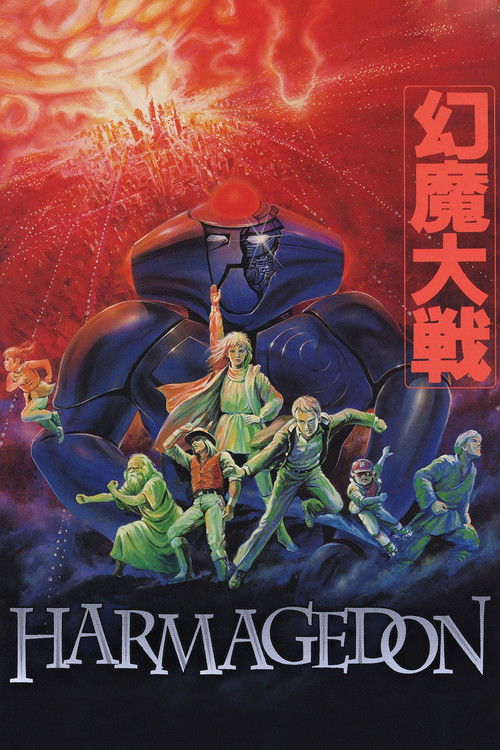
Harmagedon
Plot
From the depths of space he is coming... Ancient beyond understanding, his power is immeasurable. He has destroyed half the universe and is on his way here. He is… Genma. Only two people are aware of the imminent catastrophe: Princess Luna, a modern day prophetess and Vega, a cybernetic crusader from a world long since ravaged by Genma. Determined to spare the Earth from a similar fate, Luna and Vega must try to mobilize the most potent psychics in the world. Together, this army of fledging psychic warriors must succeed where billions have tried... and failed. But will they be able to gather their champions in time? Genma’s agents are already on Earth to ensure that their master meets with no opposition!
Get the Weekly Woke Watchlist
New and trending movies scored for woke bias, preachy messaging, and forced political themes — before you waste your evening.
No spam. One useful email per week.
Overall Series Review
Categorical Breakdown
The hero team is explicitly multinational, including a Saudi Arabian man, a Native American man, and a Chinese girl, which appears intentionally designed to emphasize world unity and diversity. The narrative includes a moment where a main character is directly accused of racism for failing to connect with a black teammate, forcing the story to pause for a lecture on racial prejudice. The main conflict is resolved not by character merit alone, but by a global collective whose diversity is a key element of their strength.
The movie portrays Earth's civic structures, including police (NYPD) and government officials, as compromised or possessed by the alien enemy. All existing authority figures are either malevolent agents of Genma or completely ineffective. Both New York City and Tokyo are shown to be ruined and chaotic urban landscapes. Salvation does not come from Earth's own institutions but from an alien cyborg and a group of psychic teenagers, suggesting established civilization is fundamentally corrupt or powerless against true chaos.
The main female lead, Princess Luna, is a powerful psychic, prophetess, and recruiter, making her a co-leader of the mission. She is not a 'Mary Sue' figure, as her role is complementary and she is even criticized for her prejudice. The Japanese male protagonist, Joe Azuma, is established as the most powerful psychic and the one who delivers the final strike. The male lead is initially a bumbling, reluctant teenager, suggesting a degree of emasculation, but he ultimately rises to become the savior.
The narrative focuses on an existential, world-ending conflict and contains no themes related to sexual identity, gender ideology, or the deconstruction of the nuclear family. The primary relationship dynamic is a traditional complementary partnership between a male and female lead, and the main hero's sister represents a traditional familial bond that he must protect.
The film replaces traditional religious belief with an abstract, non-denominational 'universal love consciousness' as the source of good power. This New Age cosmic spiritualism frames the battle as pure good versus pure evil, avoiding traditional anti-theism but sidestepping organized religion. The transcendent moral law is present, but it is defined by nebulous psychic 'love' and 'unity' rather than theological doctrine or objective truth.
Get the Weekly Woke Watchlist
New and trending movies scored for woke bias, preachy messaging, and forced political themes — before you waste your evening.
No spam. One useful email per week.