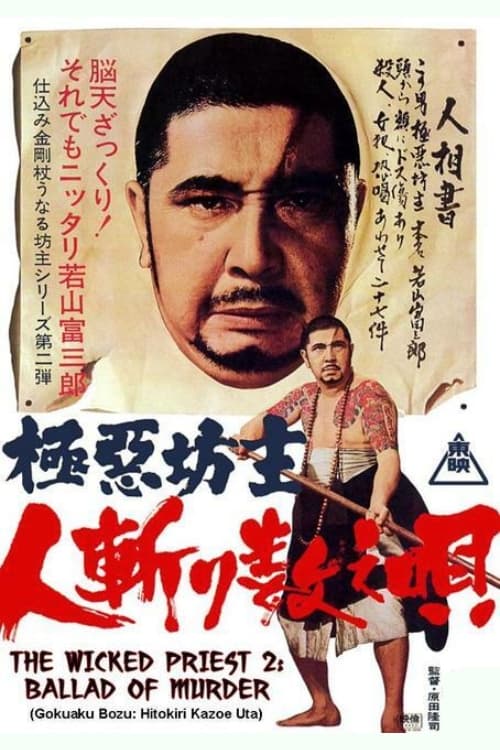
Wicked Priest 2: Ballad of Murder
Plot
The long awaited second film in the Wicked Priest series is a masterpiece of sword swinging fury as Shinkai is asked by a man on the run to bring his young son to live with his grandfather, the master of a ju-jitsu dojo during the Taisho period of the early 20th century. Shinkai then runs afoul of a gangster group using strong-arm tactics to take over the profits from local gambling. When he proves to be more than they can handle, they hire the one man who has the ability to kill Shinkai and exact revenge, Ryotatsu, the karate priest whom Shinkai blinded in the first film. This ultra-violent entry has long been considered the best movie in the series and never made its way to home video before. See a spectacular display of Wakayama Tomisaburo’s martial art expertise in this action packed film. The Holy Grail of sword movies has arrived at last! /Winterheart of CG
Get the Weekly Woke Watchlist
New and trending movies scored for woke bias, preachy messaging, and forced political themes — before you waste your evening.
No spam. One useful email per week.
Overall Series Review
Categorical Breakdown
The narrative is set in Japan, concerns Japanese characters, and the conflict is purely between a moral anti-hero and common criminals/corrupt elites. Character merit, particularly martial arts skill and moral intention, drives the plot. No elements of Western 'whiteness' vilification, intersectional hierarchy, or diversity mandates are present.
The film's criticism is aimed squarely at corrupt individuals—gangsters, politicians, and hypocritical priests—not the Taisho-era Japanese culture or civilization as a whole. The hero acts to restore order and protect core communal institutions like the family unit and the common people. This constitutes a critique of corruption, not civilizational self-hatred.
The main hero, Shinkai, is a highly masculine and overtly sexualized character who 'chases after women' and protects them from harm by 'wicked men.' Women in the film are depicted as either sexual objects, victims of the Yakuza (prostitutes), or maternal/romantic figures, which is the inverse of the 'Girl Boss' or 'Mary Sue' trope. The core emotional plot centers on a paternal figure (Shinkai) protecting a child, celebrating the protective masculine and paternal role.
The story adheres to a normative structure, with the main emotional drive being a traditional family dynamic (father, son, grandfather) and male-female romantic/sexual dynamics. There is no presence of alternative sexual ideologies, deconstruction of the nuclear family, or lecturing on gender theory.
The protagonist is a 'Wicked Priest' who rejects institutional piety by drinking, gambling, and killing, and the antagonists include 'corrupt priests.' This suggests anti-clericalism and a critique of institutional religion. However, the hero’s quest is for moral justice, acknowledging a clear objective truth (good vs. evil) and a higher moral law to defend the innocent. This is a critique of hypocrisy, not a total embrace of moral relativism, keeping the score low.
Get the Weekly Woke Watchlist
New and trending movies scored for woke bias, preachy messaging, and forced political themes — before you waste your evening.
No spam. One useful email per week.