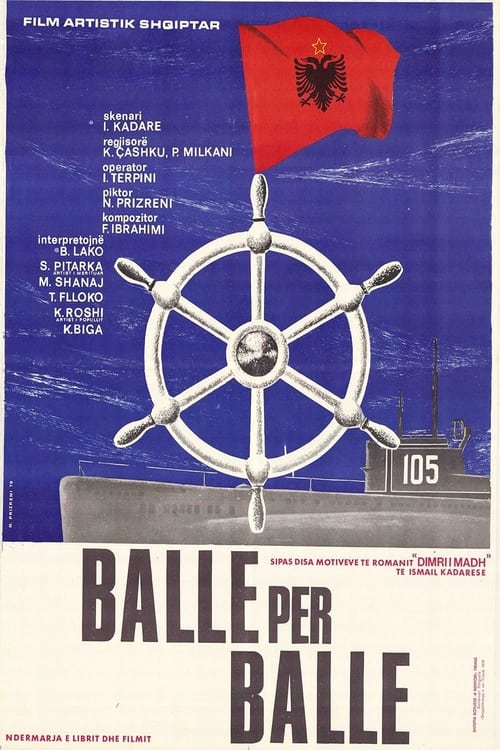
Face to Face
Plot
A translator at the conference of communist parties witnessed the biggest break between the two communist parties. The dramatic events in the military conflict take place on a naval base in Albania, which the Soviets did not dare to adopt. Based on a novel by Ismail Kadare.
Get the Weekly Woke Watchlist
New and trending movies scored for woke bias, preachy messaging, and forced political themes — before you waste your evening.
No spam. One useful email per week.
Overall Series Review
Categorical Breakdown
The core conflict is based on national and political identity (Albanian sovereignty vs. Soviet revisionism), not Western intersectional race or privilege hierarchy. Characters are judged by their loyalty to the nation and the Party's ideology. The concept of 'whiteness' as a vilified group is irrelevant to the film’s geopolitical focus.
The film acts as a piece of nationalistic propaganda, celebrating the 'home' culture (the Albanian communist state) for its revolutionary purity and national defiance against the Soviet 'revisionist' external threat. The narrative promotes national gratitude and sovereignty, directly opposing the definition of civilizational self-hatred.
The primary storyline is military and political, dominated by male characters (commanders, translator, commissars). Female characters are present but occupy traditional or supporting roles of the era, such as a local woman and a Russian interpreter. There is no presence of the modern 'Girl Boss' or 'Mary Sue' trope, nor is there any anti-natalist or male-emasculating messaging; the gender dynamic is simply traditional for a film about military confrontation.
As a state-produced film from 1979 Albania, which was highly restrictive, the narrative is completely devoid of any LGBTQ+ themes. The focus is strictly on political and military confrontation. There is no centering of alternative sexualities or any form of 'queer theory' lens.
The film is produced by a state that was officially and institutionally anti-theistic, replacing transcendent morality with the 'objective' truth of the Party's ideology (Marxism-Leninism-Hoxhaism). While the plot is not a religious polemic, the entire moral and philosophical framework rejects Objective Truth and traditional religion in favor of state-mandated political morality, warranting a high score, even though the attack is not directly on Western Christianity.
Get the Weekly Woke Watchlist
New and trending movies scored for woke bias, preachy messaging, and forced political themes — before you waste your evening.
No spam. One useful email per week.