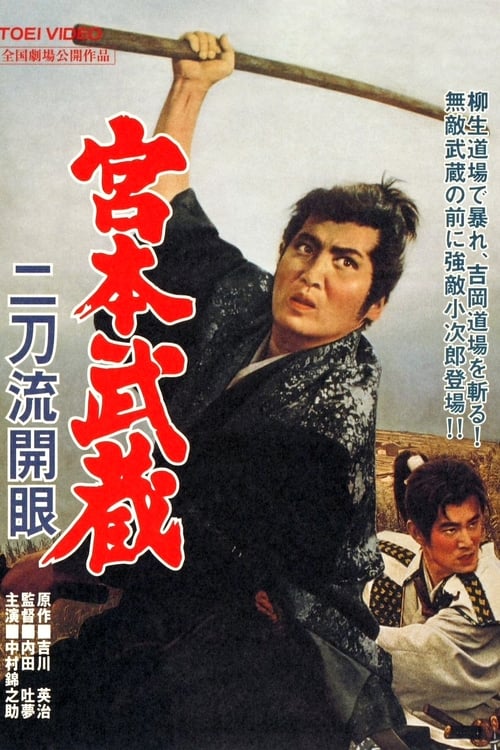
Miyamoto Musashi: Birth of Two Sword Style
Plot
In the third installment of Yoshikawa's novel Musashi, things continue from the 2nd film at the end of battle, where Miyamoto continues on a mission of learning; with the introduction of his arch-rival Sasaki Kojiro; and lastly the large cast of characters rendezvouses for a fateful finale.
Get the Weekly Woke Watchlist
New and trending movies scored for woke bias, preachy messaging, and forced political themes — before you waste your evening.
No spam. One useful email per week.
Overall Series Review
Categorical Breakdown
The film is a period piece utilizing an entirely ethnically and culturally authentic Japanese cast playing Japanese historical figures, with no evidence of forced diversity or race-swapping. The core theme is one of universal meritocracy, where the protagonist's status and success are determined solely by his skill, discipline, and personal journey, not by group identity or intersectional hierarchy.
The movie is a national epic and cultural monument celebrating a legendary figure from Japanese history and the foundational philosophies of Bushido and self-mastery. It is an expression of deep respect for its home culture and ancestors. There is no criticism of Western civilization, thus scoring the lowest possible based on the prompt's definition.
Female characters like Otsu serve as moral anchors and love interests for Musashi, emphasizing traditional roles of loyalty, care, and family-oriented desire. While Otsu is independent in her journey to follow Musashi, her primary narrative function is one of complementary support. The film does not feature any 'Girl Boss' tropes, emasculation of males, or anti-natalist messaging, reflecting the traditional gender dynamics of a mid-century period piece.
The film is a traditional historical epic focused on the personal and professional journey of a male hero in feudal Japan. The central romantic thread is a normative male-female pairing, and the narrative contains no explicit alternative sexual ideology, deconstruction of the nuclear family, or lecturing on modern gender theory.
Musashi's personal spiritual philosophy, derived from Zen Buddhism, is captured by his maxim to 'Respect Buddha and the gods without counting on their help'. The film's spirituality centers on the philosophical pursuit of the 'Way of the Sword' and self-mastery as a path to enlightenment. This is a focus on transcendent morality and self-discipline, not a critique or vilification of religion, though it encourages self-reliance over simple faith-based dependence.
Get the Weekly Woke Watchlist
New and trending movies scored for woke bias, preachy messaging, and forced political themes — before you waste your evening.
No spam. One useful email per week.