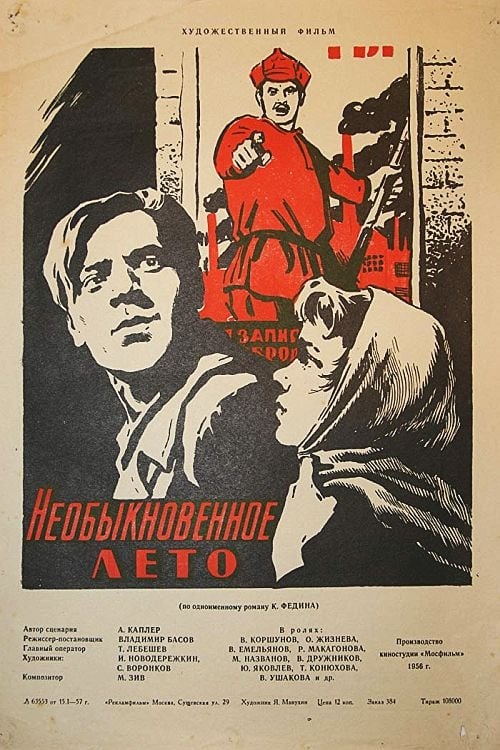
An Unusual Summer
Plot
The film takes place in 1919 in Saratov. Student Kirill Izvekov becomes Commissioner of the Red Army and participates in the battle with Wrangel and the capture of the city.
Get the Weekly Woke Watchlist
New and trending movies scored for woke bias, preachy messaging, and forced political themes — before you waste your evening.
No spam. One useful email per week.
Overall Series Review
Categorical Breakdown
The narrative is centered on a class and political struggle (Bolshevik vs. White Army), which substitutes for modern race and intersectional politics. Character merit is judged by loyalty and service to the communist cause, not immutable characteristics. There is no vilification of 'whiteness' in the modern sense; the conflict is between two groups of ethnic Russians over ideology. The focus is a universal, class-based struggle rather than identity hierarchy.
The film’s entire premise is the glorification of the violent overthrow of the ancestral Russian state and its institutions (Tsarism, the White Army, the aristocracy). The narrative frames the core Russian home culture and its past as fundamentally corrupt and evil, which must be destroyed to build the 'superior' socialist future. This is a textbook civilizational self-hatred and a rejection of ancestors' sacrifices, prioritizing the new political ideology over the nation’s history.
As a Soviet-era film, the narrative is strongly aligned with the state's ideology of gender equality through political and labor participation. Female characters are typically depicted as politically conscious and active participants in the revolution or workforce. This messaging implicitly devalues traditional motherhood and family structure, framing a career or duty to the state as the primary or only source of fulfillment, which aligns with anti-natalism and the prioritization of the state over the nuclear family, although it avoids the 'Girl Boss' trope.
The 1957 Soviet context ensures a strict focus on traditional male-female pairing and the nuclear family as the standard, albeit one subservient to the state. Overt alternative sexualities, deconstructing the family, or gender ideology are not present, as these topics were actively suppressed by the state apparatus. The structure is entirely normative with no lecturing on sexual or gender theory.
The film is produced by a state founded on Marxist-Leninist principles, which are fundamentally atheist and anti-religious, defining religion (specifically the Russian Orthodox Church) as 'the opium of the masses' and a tool of the oppressive former regime. The narrative promotes a purely materialistic, political morality and acknowledges no Objective Truth or higher moral law outside of the communist party's dialectical materialism. Traditional religion is inherently viewed as an element to be suppressed.
Get the Weekly Woke Watchlist
New and trending movies scored for woke bias, preachy messaging, and forced political themes — before you waste your evening.
No spam. One useful email per week.