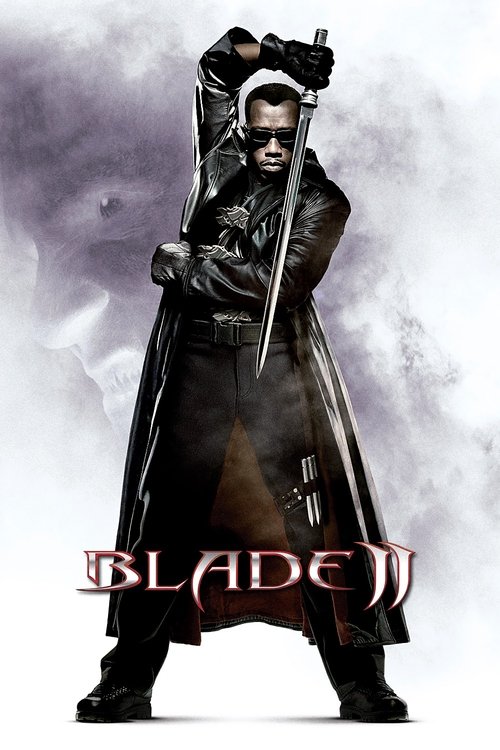
Blade II
Plot
Blade forms an uneasy alliance with the vampire council in order to combat the Reapers, who are feeding on vampires.
Get the Weekly Woke Watchlist
New and trending movies scored for woke bias, preachy messaging, and forced political themes — before you waste your evening.
No spam. One useful email per week.
Overall Series Review
Categorical Breakdown
The hero, Blade, is a biracial, non-white protagonist who is universally superior to almost every antagonist and ally. His merit is strictly based on his unmatched skill and unyielding moral code. The antagonists and the corrupt vampire aristocracy, including the Overlord Damaskinos and the arrogant Bloodpack leader Reinhardt, are depicted as a pale/white-coded elite, who are incompetent, treacherous, and evil. This setup places a non-white hero against a corrupt white elite, a potential inverse of the 'vilification of whiteness,' but the conflict is fundamentally one of species (human-vampire hybrid vs. vampire) and morality (protecting humanity vs. preying on it), not a lecture on systemic oppression.
The central conflict is the protection of the human race from an existential, monstrous threat—the Reapers, and by extension, the traditional vampires they are forced to fight. The film does not criticize Western civilization or its institutions; it operates in a subterranean world of monsters. Blade's mission is purely defensive, reinforcing the idea that the human world is worth saving from chaos. The only 'civilization' deconstructed is the ancient, corrupt, aristocratic Vampire Nation itself.
The primary female character, Nyssa, is highly competent as a scientist and a fighter in the elite Bloodpack unit. She is a strong, capable character but is not portrayed as flawless or instantly superior to all men, which avoids the 'Mary Sue' trope. Blade's supreme competency means he is not emasculated. The few relationships shown, like Nyssa's connection with Blade and Verlaine’s pairing with Lighthammer, are traditional. The film is entirely focused on action and does not include any anti-family or anti-natalism messaging.
The film does not contain any storylines that center on alternative sexual identities, queer theory, or gender ideology. The core relationship dynamics are male-female, and any overt sexuality is a secondary element of the dark, violent setting. Sexuality is private and is not used as a vehicle for political lecturing or deconstruction of the nuclear family as an 'oppressive' structure.
The conflict is based on classic monster mythology where the creatures are repelled by traditional religious iconography (crosses/sunlight/garlic), though Blade's methods are high-tech and secular. The movie presents a clear, objective moral law: killing monsters is good, preying on humans is evil. Traditional religion is neither overtly demonized nor celebrated, simply forming a backdrop of objective evil versus objective good without adopting moral relativism or portraying Christian characters as villains.
Get the Weekly Woke Watchlist
New and trending movies scored for woke bias, preachy messaging, and forced political themes — before you waste your evening.
No spam. One useful email per week.