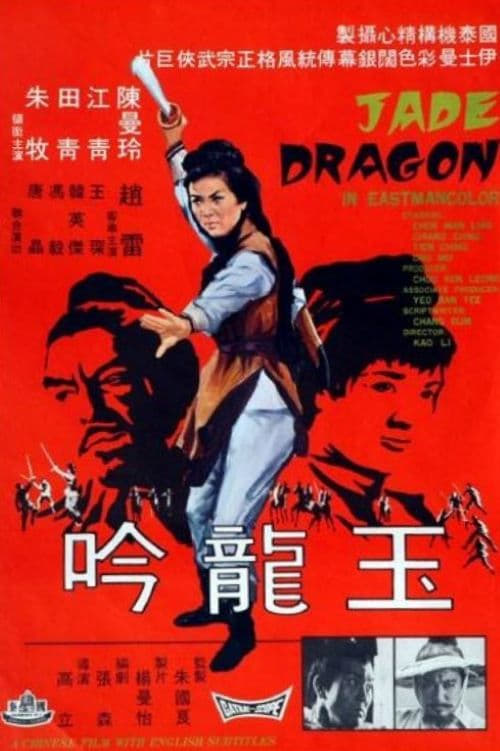
Jade Dragon
Plot
Old school weepy sword fighting epic with Melinda Chen Man Ling, Cathay's answer to Cheng Pei Pei.
Get the Weekly Woke Watchlist
New and trending movies scored for woke bias, preachy messaging, and forced political themes — before you waste your evening.
No spam. One useful email per week.
Overall Series Review
Categorical Breakdown
The film is a Hong Kong wuxia epic, which places the narrative entirely within a Chinese cultural context. Characters are judged by their martial arts skill, loyalty, and personal honor in the jianghu, which is pure Universal Meritocracy. The concepts of 'whiteness' vilification or forced diversity are entirely absent and irrelevant to the plot.
The film is not Western media and therefore does not engage in hostility toward Western civilization. It is an exploration and celebration of a key element of Chinese culture—the martial arts epic—and its ancestors (the genre's legends). The narrative celebrates core cultural institutions and does not demonize its home culture.
The main role is played by a female action star, Melinda Chen Man Ling, as a powerful swordswoman. This strong female presence aligns with the classic nüxia (female knight-errant) trope in wuxia, where women are highly competent fighters. This capability earns a 2, but the narrative is a 'weepy sword fighting epic,' suggesting the strong character's journey is driven by classic moral or emotional themes, not a modern lecture about men being bumbling idiots or a rejection of motherhood.
As a Hong Kong action film from 1968, the structure is fundamentally normative. Sexuality is not centered as an ideology. The traditional male-female pairing and nuclear family structure (or their disruption via classic conflict) form the standard basis of the narrative world.
The wuxia genre is defined by a deep moral code (the jianghu code of ethics) which functions as a transcendent moral law. This is a story about justice and honor, where faith and moral principles are acknowledged as a source of strength, making the narrative antithetical to moral relativism.
Get the Weekly Woke Watchlist
New and trending movies scored for woke bias, preachy messaging, and forced political themes — before you waste your evening.
No spam. One useful email per week.