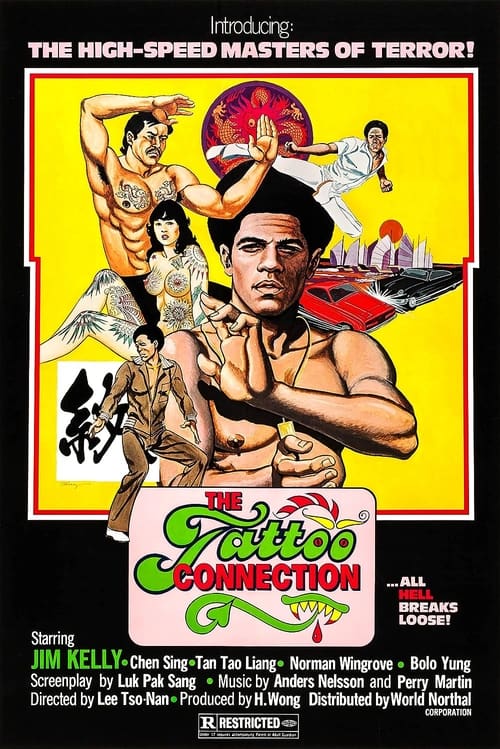
The Tattoo Connection
Plot
When a diamond is stolen in Hong Kong, the company insuring the diamond sends a former CIA agent to Hong Kong to retrieve it. Meanwhile, one of the thieves begins to have a change of heart because his girlfriend wants him to leave his criminal organization.
Get the Weekly Woke Watchlist
New and trending movies scored for woke bias, preachy messaging, and forced political themes — before you waste your evening.
No spam. One useful email per week.
Overall Series Review
Categorical Breakdown
Character success is based entirely on personal merit and fighting skill. The protagonist, a Black martial artist, is explicitly competent as a former CIA agent. The conflict is not framed as a lecture on systemic oppression or privilege, but as a classic action-crime pursuit for a diamond. The cast reflects the co-production nature (Black American lead, Chinese/Taiwanese supporting cast, both heroes and villains) without racial commentary beyond the genre's stylistic elements.
The movie is an action thriller about crime in a Hong Kong setting, with the American protagonist working for a Western entity (an insurance company). The conflict is purely secular and criminal. There is no philosophical hostility toward Western civilization, nor is there a deconstruction of heritage. The primary 'home' culture, the Hong Kong underworld, is only framed as corrupt in a genre-specific, criminal sense.
The movie contains the opposite of 'Girl Boss' tropes. The central female character, a 'dancing girl,' is portrayed as the 'property' of a criminal boss, who abuses her, and she is a victim who attempts to act as a seductress/poisoner to secure her escape. Masculinity is not emasculated; it is expressed through the martial arts competence of the male leads and the villain's brute force. Motherhood is not discussed, but the central relationship seeks a traditional family unit as a form of escape from the criminal life.
The narrative adheres to a normative structure. The key relationship is a traditional male-female pairing, and the central conflict for one male character is the desire to leave crime for a life with his girlfriend, who wants to be his wife. There is no presence of sexual ideology, centering of alternative sexualities, or deconstruction of the nuclear family.
The film's focus is on a secular crime plot and martial arts action, not religion. Traditional religion is not mentioned or targeted. The moral conflicts are confined to the criminal underworld's self-justification for their illegal actions, which is a genre convention, not a philosophical argument against Objective Truth or a higher moral law.
Get the Weekly Woke Watchlist
New and trending movies scored for woke bias, preachy messaging, and forced political themes — before you waste your evening.
No spam. One useful email per week.