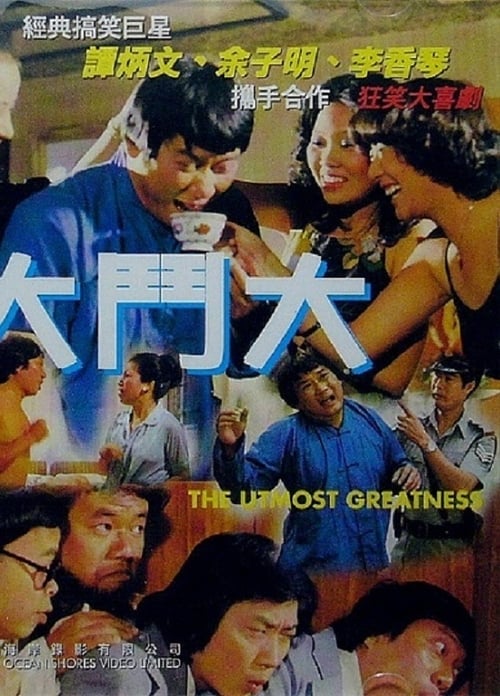
The Utmost Greatness
Plot
The Utmost Greatness is a Hong Kong Comedy starring Kent Cheng.
Get the Weekly Woke Watchlist
New and trending movies scored for woke bias, preachy messaging, and forced political themes — before you waste your evening.
No spam. One useful email per week.
Overall Series Review
Categorical Breakdown
The film is a 1979 Hong Kong production with an all-Asian cast, existing within a cultural context entirely separated from Western intersectional politics. Character conflicts and worth are determined by competence, greed, or honor within the comedic plot, not by race or immutable characteristics. There is zero reliance on the vilification of 'whiteness' or forced diversity.
As a typical Hong Kong comedy from the era, the film's setting and humor rely entirely on a baseline acceptance and celebration of its local culture and Chinese heritage. The narrative treats its home environment as normal and familiar, not fundamentally corrupt or racist, therefore showing gratitude for institutions and respecting the cultural setting without deconstruction.
While female characters may take a secondary role typical of 1970s comedies, the plot is not built around the 'Girl Boss' trope or the systematic emasculation of men. Male and female dynamics are portrayed through a traditional lens, typically involving courtship or family relationships, focused on generating simple laughs rather than delivering an anti-natalist or anti-family message.
The movie is a product of 1970s mainstream Hong Kong cinema, which did not feature the centering of alternative sexualities, deconstruction of the nuclear family, or gender ideology. The structure remains strictly normative, presenting male-female pairing as the standard and treating sexuality as a private matter, which is irrelevant to the central comedy.
As a secular comedy film, the movie does not engage in overt hostility toward religion, especially not Christianity, which is outside the main cultural context. Morality is based on simple, objective comedic standards of good/bad behavior and karma within the plot, acknowledging a transcendent moral law without political subversion or spiritual vacuum messaging.
Get the Weekly Woke Watchlist
New and trending movies scored for woke bias, preachy messaging, and forced political themes — before you waste your evening.
No spam. One useful email per week.