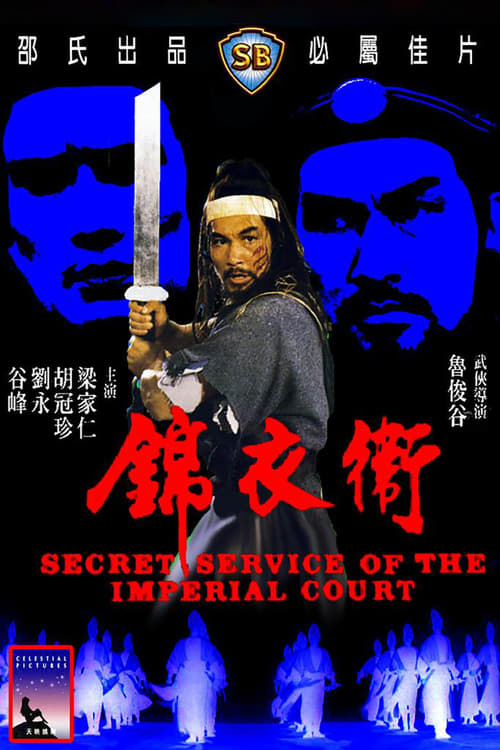
Secret Service of the Imperial Court
Plot
The sergeant of the Brocade Guards, the government's secret police, fights back against a traitorous eunuch who wishes to take the throne.
Get the Weekly Woke Watchlist
New and trending movies scored for woke bias, preachy messaging, and forced political themes — before you waste your evening.
No spam. One useful email per week.
Overall Series Review
Categorical Breakdown
The entire cast and setting are culturally and historically authentic, focusing on the Han Chinese of the Ming Dynasty. The hero's defection is based purely on a crisis of conscience and a desire for justice, not on any immutable characteristic or intersectional identity. Character value is determined by moral choice, not group affiliation.
The film's critique is directed specifically at the political corruption of a tyrannical eunuch and his misuse of the Imperial Secret Service, not a broad condemnation of Chinese civilization, history, or ancestry. The hero is fighting to restore a sense of honor, which honors a higher cultural ideal.
The main female character, Xue Liang (Nancy Hu), is the protagonist's 'tragic wife' and they have a son, placing her firmly within a complementarian, family-centric structure. Her role supports the male hero and their family unit is the core stake of the conflict. There is no 'Girl Boss' trope or anti-natalist messaging.
The primary villain is a historical Eunuch, Wang Zhen, whose position is a political and historical reality of the Imperial Court. His castration is a factor of his power, not a vehicle for a lecture on modern sexual or gender theory. The hero's family is a normative structure (husband, wife, son).
The film's central struggle between the protagonist's conscience and the villain's cruelty is a fundamentally moral one. The quest for 'honor' and 'justice' implies a belief in a transcendent, objective moral law. The movie's non-Western setting means there is no critique of Christianity, and no explicit moral relativism is promoted.
Get the Weekly Woke Watchlist
New and trending movies scored for woke bias, preachy messaging, and forced political themes — before you waste your evening.
No spam. One useful email per week.