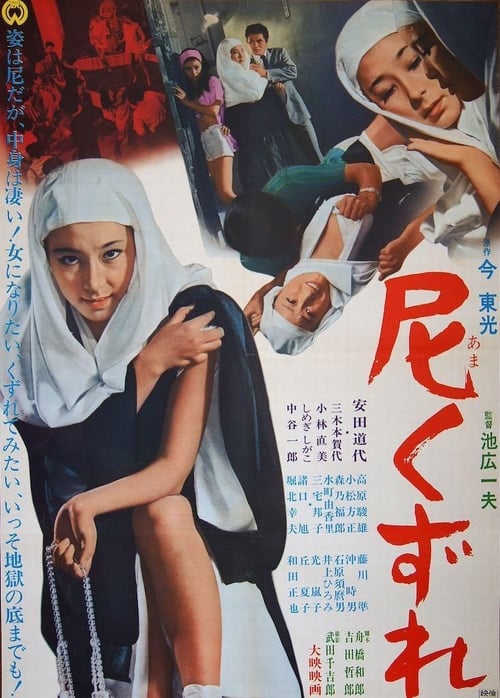
The Daring Nun
Plot
One of the nuns at Senjuan is Sister Shunko (Michiyo Yasuda). Unlike the usual nun, however, she often goes out to see the world, being of the opinion that nuns should not lead cloistered lives but should see something of modern life. She makes the acquaintance of a young girl named lkuko (Kayo Mikimoto) and saves her from the advances of a gangster named Goro (lchiro Nakatani). In the meantime she turns down several propositions and, in revenge, one of her admirers denounces her to the Mother Superior (Kuniko Miyake). This lady is of liberal views, however, and refuses to do anything about it. Then Shunko is visited by Goro's gang boss who wants lkuko back and says he will blackmail Shunko unless she agrees.
Get the Weekly Woke Watchlist
New and trending movies scored for woke bias, preachy messaging, and forced political themes — before you waste your evening.
No spam. One useful email per week.
Overall Series Review
Categorical Breakdown
The film is a Japanese production set in Japan with an entirely Japanese cast, focusing on local social conflicts; the narrative does not engage with modern concepts of intersectional hierarchy, racial grievances, or the vilification of whiteness.
The conflict is entirely internal to Japanese society, pitting the traditional Buddhist cloistered life against the vices of the modern world; it critiques a specific, restrictive institution (the nunnery) and a criminal element (gangsters) but does not frame the entire national culture or Western civilization as fundamentally corrupt or racist.
The protagonist, Sister Shunko, actively rejects the traditional, cloistered role expected of a nun and ventures into the 'modern life,' establishing her as a 'daring' and rebellious figure; she is depicted as a strong, autonomous woman who saves a girl from a gangster and rejects male advances, while the Mother Superior supports her deviance through 'liberal views,' validating the rejection of traditional female roles.
The film’s genre tags explicitly include 'Lesbian Supporting Character,' 'Lesbian Romance,' and 'LGBTQ+,' indicating a clear and central focus on alternative sexuality. The inclusion of this content within a religious convent setting constitutes a deliberate, intense deconstruction of the traditional, normative structure.
The core of the plot involves the protagonist rejecting her religious vows and lifestyle to seek 'modern life,' which is celebrated by the Mother Superior, positioning traditional faith as a repressive environment to be escaped; the use of the nunnery as the setting for an exploitation film focused on eroticism and scandal undermines the sanctity of the religious institution.
Get the Weekly Woke Watchlist
New and trending movies scored for woke bias, preachy messaging, and forced political themes — before you waste your evening.
No spam. One useful email per week.