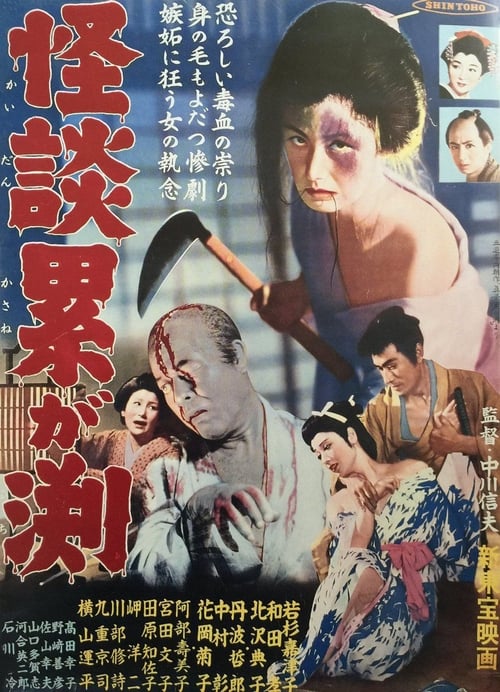
The Ghost of Kasane
Plot
A blind masseur visits a samurai to request the return of a loan. The samurai kills him in anger, then has his servant dump the body in the Kasane swamp. However, the ghost of the masseur returns to haunt the samurai, who kills his wife by mistake and then goes to the swamp and drowns himself. 20 years later, the masseur's daughter unknowingly falls in love with the samurai's son who has been brought up to be a servant. After she is horribly disfigured in an accident, he plots to run away with another woman, but the path of their escape lies by the Kasane swamp...
Get the Weekly Woke Watchlist
New and trending movies scored for woke bias, preachy messaging, and forced political themes — before you waste your evening.
No spam. One useful email per week.
Overall Series Review
Categorical Breakdown
The central conflict involves a samurai killing a blind masseur over a debt, establishing a power dynamic of high-status versus low-status/disabled individual. However, the narrative treats the samurai’s action as a sin of personal avarice and violence, not a lecture on systemic class oppression. Character fates are driven by the curse of bad karma, not a political intersectional hierarchy. Casting is historically and culturally appropriate to Edo-period Japan, featuring no forced diversity or 'race-swapping' for a modern political agenda.
The film is based on a popular Japanese folktale and is set in the country’s Edo period, rooted deeply in its own national culture and tradition. The horror derives from an internal moral failing (greed, murder) and the resulting supernatural curse tied to a specific local swamp. There is no hostility or critique directed at Western civilization or any deconstruction of Japanese heritage; the institutions (samurai class, family, debt structure) merely serve as the authentic backdrop for a universal tale of human corruption and spiritual consequence.
Female characters, such as the masseur's daughter Rui/Oshiga, are figures of love, tragedy, disfigurement, and supernatural vengeance. The power she wields is as a vengeful ghost, a traditional horror trope, not as a 'Girl Boss' political archetype. The male lead is depicted as 'meek' but is also flawed, showing weakness and betrayal by abandoning the woman he loves when she is disfigured. The story focuses on doomed romance and betrayal, and it does not contain any anti-natal or anti-family messaging.
The core relationships are exclusively traditional male-female pairings that lead to a tragic curse. The narrative focuses on the consequences of betrayal and murder within the context of a doomed heterosexual romance. The movie contains no elements of centering alternative sexualities, deconstructing the nuclear family as an 'oppressive' structure, or lecturing on contemporary gender ideology.
The entire plot is built upon the concept of transcendent morality and spiritual law. The force driving the plot is a 'vengeful spirit' and a concept of 'bad karma,' where sin leads inevitably to supernatural punishment that spans generations. The review notes that the only redemption comes in the 'afterlife.' This profound emphasis on a higher, objective spiritual consequence for immoral actions places the film in direct opposition to moral relativism or a spiritual vacuum.
Get the Weekly Woke Watchlist
New and trending movies scored for woke bias, preachy messaging, and forced political themes — before you waste your evening.
No spam. One useful email per week.