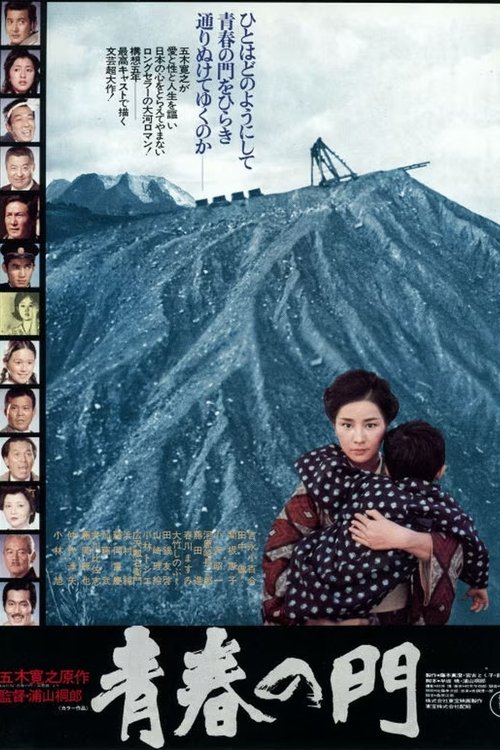
The Gate of Youth
Plot
Mainly the story of Shinsuke and his stepmother, ranging from Shinsuke's infanthood to his mid-teens. Coal workers and the mines dominate nearly every aspect of the life of the characters. Shinsuke's father dies while bravely using dynamite to rescue a group of trapped Korean miners. Several older men attempt to help he and his mother cope, including a kind Korean and a Harley-riding yakuza.
Get the Weekly Woke Watchlist
New and trending movies scored for woke bias, preachy messaging, and forced political themes — before you waste your evening.
No spam. One useful email per week.
Overall Series Review
Categorical Breakdown
The plot contains a racial element, but it is used to celebrate universal meritocracy and condemn individual bigotry. The Japanese father's heroic sacrifice for Korean miners establishes that character is judged by merit and courage, not race. A kind Korean and a yakuza figure both step in to help the family. The Japanese stepmother punishes her son for ganging up on a Korean boy, establishing a clear moral line against prejudice, which prevents the score from being the absolute minimum of 1.
The film depicts the home culture and community with deep respect and vitality. The mining town is framed as a place of hardship but also a crucible for noble character, where the family unit and heroic ancestors are celebrated. The protagonist's father is revered as a 'natural leader' and hero, and the story’s moral core defends the family institution, rejecting any form of civilizational self-hatred.
The stepmother's character, Tae, is the moral and emotional anchor of the story. She is not a 'Girl Boss' who rejects men or family; her strength comes from her fidelity to her deceased husband and her fierce, protective devotion to her stepson. She works in the mine out of necessity, not as a career-based rejection of motherhood. The film celebrates the protective nature of men (the father's sacrifice) and the complementary, vital strength of the maternal figure.
The narrative focus is entirely on the nuclear family structure and traditional male-female dynamics in a historical, working-class setting. The story contains no presence of alternative sexual ideology, queer theory, or any deconstruction of the nuclear family unit. Sexuality remains private, and the structure is purely normative.
The narrative is centered on a strong, objective moral framework where courage, sacrifice, and fidelity are absolute virtues. The moral landscape is defined by the characters' commitment to honor and family, not a spiritual vacuum. There is no hostility or critique directed at traditional religion, and morality is clearly transcendent rather than subjective.
Get the Weekly Woke Watchlist
New and trending movies scored for woke bias, preachy messaging, and forced political themes — before you waste your evening.
No spam. One useful email per week.