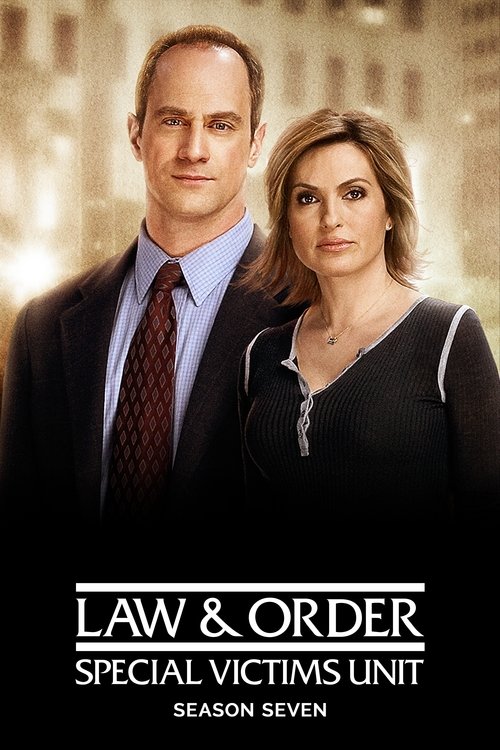
Law & Order: Special Victims Unit
Season 7 Analysis
Season Overview
The unit's gut-wrenching cases include a schoolyard shooting of a child, a shady dating service and a shocking revelation regarding Tutuola's son.
Season Review
Categorical Breakdown
The episode 'Raw' makes race and ideological hatred central to the villain's identity. The crime—a Neo-Nazi white supremacist group's violence against a young Black child adopted by white parents—explicitly frames white supremacy as a clear and present systemic evil. This reliance on a villain defined purely by their immutable characteristics (race) and hateful ideology is used as a narrative vehicle to lecture on systemic oppression, resulting in a high score.
The score remains low because the core institutional characters are police officers and prosecutors who are depicted as fundamentally good and fighting for justice, which is a defense of American civic institutions. The enemies are internal—domestic criminals, drug rings, and hate groups (like the Neo-Nazis in 'Raw')—not a critique of Western civilization itself. The system is the solution, not the problem.
Female leads like Detective Benson and ADA Novak are consistently portrayed as competent, highly moral, and professional, which fits the 'Girl Boss' archetype. However, male co-leads Stabler and Munch are also portrayed as capable and vital to the unit's function, preventing the emasculation score from reaching the highest levels. The overall dynamic is one of professional complementarianism within the workplace, albeit with a strong leaning toward female moral authority.
The score is very high due to the forced centering of alternative sexualities. The episode 'Strain' makes Tutuola's difficulty accepting his son's homosexuality a primary emotional arc, using the son's 'coming out' to the police (Benson) as a progressive moral standard against the detective's 'traditional' discomfort. The episode 'Alien' directly centers a legal case around the rights of same-sex parents (a lesbian couple), using the criminal case to validate the deconstruction of the nuclear family as a normative structure.
There is no explicit vilification of traditional religion, specifically Christianity, in the central plotlines. The show's morality is fundamentally secular, deriving from the rule of law and humanistic compassion rather than divine or transcendent moral law. The villains and moral conflicts are secular (e.g., neo-Nazis, drug dealers, sex offenders), keeping the score low as it avoids actively attacking religion, instead creating a spiritual vacuum.