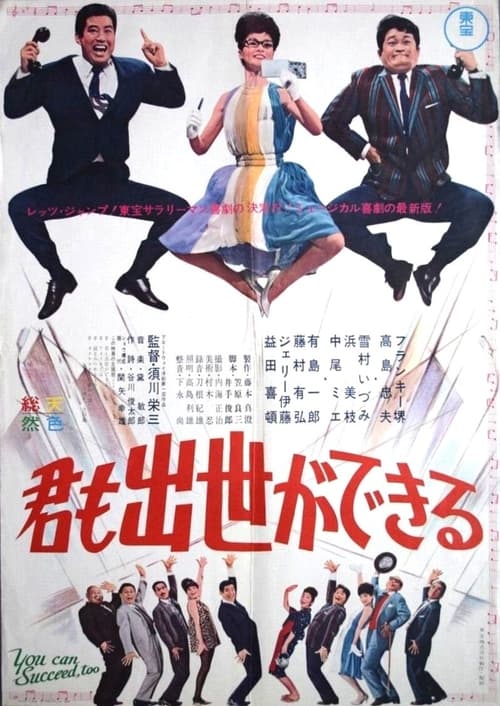
You Can Succeed, Too
Plot
A group of friends try to find success in corporate Japan.
Get the Weekly Woke Watchlist
New and trending movies scored for woke bias, preachy messaging, and forced political themes — before you waste your evening.
No spam. One useful email per week.
Overall Series Review
Categorical Breakdown
The narrative is focused on professional ambition, corporate satire, and the cultural clash between tradition and modernity. The characters are judged by their sincerity, ambition, and work ethic, reflecting a theme of universal meritocracy. There is no focus on race, immutable characteristics, or intersectional hierarchy, as the cast is ethnically authentic to its Japanese setting.
The film satirizes both the cynical, corrupt aspects of traditional Japanese corporate life (e.g., the boss's illicit affairs) and the unthinking, rigid adoption of 'American efficiency.' The ending does not champion traditionalism but promotes a 'no-place' utopia that represents a uniquely reinvented Japanese identity, which critiques both old domestic systems and foreign cultural dominance. This is a critique of a system or 'economic animal' lifestyle, not a wholesale condemnation of the culture or nation itself.
The female lead, Yoko, is an executive who implements radical corporate change, representing a 'Girl Boss' with 'American efficiency.' However, one of her songs expresses a traditional female worry about 'aging without a husband.' The plot resolves with the main couples finding traditional romantic fulfillment, and one secondary female character is depicted as a gold-digging mistress. The film presents a mix of female corporate power and ultimate traditional pairing, resulting in a low-to-moderate score.
The narrative centers entirely on traditional male-female pairings and heterosexual corporate romances. There is no depiction, centering, or lecturing on alternative sexualities, gender ideology, or the deconstruction of the nuclear family unit. The focus is exclusively on the normative structure of the era.
The core critique of the film is aimed at corporate greed, capitalism, and cultural assimilation, not religion. The story's ultimate value is placed on sincerity and goodwill, which are presented as objective moral virtues that triumph over cutthroat, amoral corporate ambition. There is no hostility toward religion or a promotion of moral relativism; the themes are purely secular-economic and moral-character focused.
Get the Weekly Woke Watchlist
New and trending movies scored for woke bias, preachy messaging, and forced political themes — before you waste your evening.
No spam. One useful email per week.