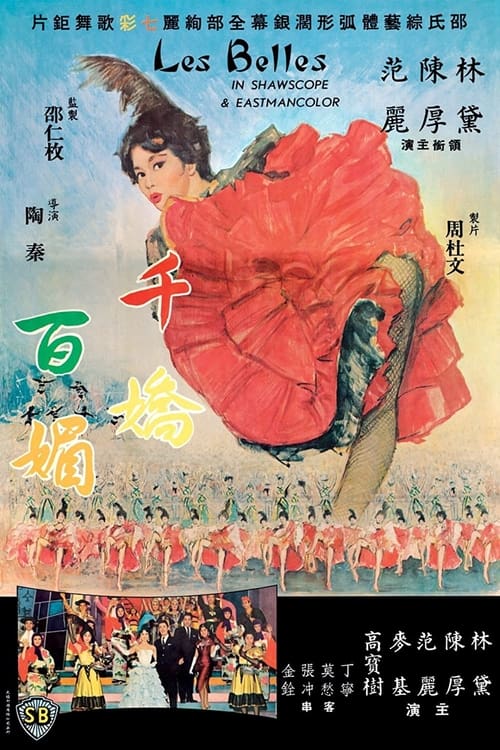
Les Belles
Plot
Linda Lin Dai and Fanny Fan join the dancing troupe of Kao Pao-shu. Linda and Kao's son Peter Chen, manager of the troupe, have misunderstandings and dislike each other.
Get the Weekly Woke Watchlist
New and trending movies scored for woke bias, preachy messaging, and forced political themes — before you waste your evening.
No spam. One useful email per week.
Overall Series Review
Categorical Breakdown
The movie is a Hong Kong production from 1961 featuring a full East Asian cast. The narrative is driven by classic romantic comedy conflict and the professional merit of the lead dancers. There is no focus on race, intersectional hierarchy, or political lectures about privilege. Character value is defined by artistic talent and moral character.
The movie celebrates the art of the dance troupe, which successfully blends both Western (Can-can, Mambo) and diverse Asian cultural forms (Chinese flower-drum, Thai dance, Peking opera). The film is a high-budget spectacle from a major studio that affirms its own cultural and cinematic heritage. There is no narrative hostility toward its own home, ancestors, or civilization.
The female lead is a celebrated and highly successful professional dancer who wins multiple awards for her performance in the story. This establishes her as highly competent, but the narrative arc is primarily a traditional heterosexual romance where the focus is on a desired male-female union. There is no explicit anti-natalist or anti-family messaging, and the male lead is a functional manager/impresario, not depicted as incompetent or toxic.
The core of the plot is a classic, anonymous correspondence-style heterosexual romantic pairing between a man and a woman. The entire story is structured around the development and eventual revelation of this traditional courtship. Alternative sexualities or gender ideology are absent from the narrative, maintaining a normative male-female structure.
The movie is a musical romantic comedy with a focus on talent, dancing, and light-hearted romantic conflict, leaving no room for theological debate. The presence of traditional cultural performances, including a Thai dance 'for the gods,' indicates a cultural appreciation or at least a neutral stance toward spiritual expression, with no anti-religious or anti-Christian hostility.
Get the Weekly Woke Watchlist
New and trending movies scored for woke bias, preachy messaging, and forced political themes — before you waste your evening.
No spam. One useful email per week.