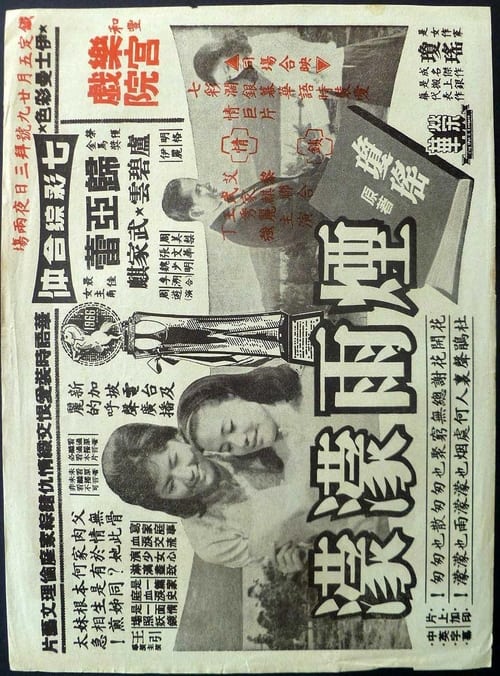
The Rain of Sorrow
Plot
Adaptation of Chiung Yao's novel "Fire and Rain".
Get the Weekly Woke Watchlist
New and trending movies scored for woke bias, preachy messaging, and forced political themes — before you waste your evening.
No spam. One useful email per week.
Overall Series Review
Categorical Breakdown
The film is a 1965 Taiwanese production featuring an ethnically authentic Chinese cast. The central conflict is one of class and family dynamics (abandonment, poverty vs. wealth) within an East Asian setting, not 'race' or 'whiteness' vilification. Characters are judged by their actions and emotional turmoil, not immutable characteristics or intersectional hierarchy.
The narrative is a domestic drama set entirely in Taiwan focused on internal family and romantic struggles. The movie critiques a patriarchal family system (the father’s polygamy/abandonment), but this is an internal cultural critique, not hostility toward 'Western civilization,' 'Western ancestors,' or framing an external culture (like aliens) as morally superior.
The female protagonist, Yi Ping, is defined by her struggle against poverty and the consequences of her father's abandonment, suggesting a theme of female suffering in a patriarchal context. While the plot focuses on a love triangle and romance, the depiction of an embittered mother and a struggling daughter pushes the score slightly above the minimum, as it does not wholeheartedly celebrate traditional roles, but it is far from 'Girl Boss' or 'Anti-Natalism' ideology.
The core plot is a traditional heterosexual love triangle involving Yi Ping, her half-sister, and Ho Shu Huan. As a 1965 Taiwanese melodrama, there is no evidence of centering alternative sexualities, deconstructing the nuclear family as an 'oppressive' structure, or promoting gender ideology. The structure is entirely normative.
The film is a secular melodrama centered on personal and familial emotional conflict. There is no mention of religion (Christianity or otherwise) in the plot, nor any theme of moral relativism versus objective truth. Faith is neither a source of strength nor the root of evil; it is simply absent from the dramatic calculus.
Get the Weekly Woke Watchlist
New and trending movies scored for woke bias, preachy messaging, and forced political themes — before you waste your evening.
No spam. One useful email per week.