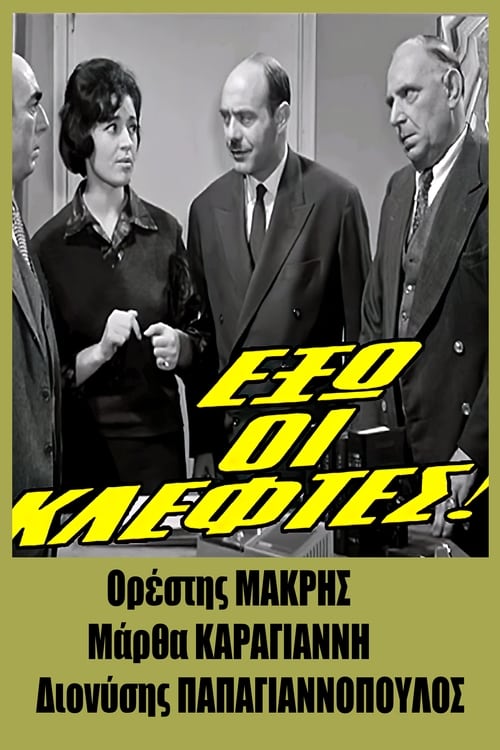
Thieves out!
Plot
When the general manager who possesses 70% of the shares of a steelworks learns that he is sick and has to go abroad to be cured, he hands his shares to Timoleon Adamantas (Orestis Makris), his brother, a teacher, with whom he hasn’t spoken for almost 30 years. Timoleon, being an honest and goodhearted man, aided by his brother’s secretary, Margarita (Martha Karagianni), with whom his son Andreas is in love, finds out a number of great administrative irregularities. Immediately, he throws out his brother’s number one assistant, Kleftodimos (Dionysis Papagiannopoulos) and Margarita as well and puts everything in order.
Get the Weekly Woke Watchlist
New and trending movies scored for woke bias, preachy messaging, and forced political themes — before you waste your evening.
No spam. One useful email per week.
Overall Series Review
Categorical Breakdown
Characters are judged purely on the content of their character, specifically their honesty and administrative competence versus corruption. Timoleon is a hero because he is 'honest and goodhearted.' Meritocracy is the universal standard for judging character and action.
The plot focuses on cleaning up corruption within the Western institution of the steelworks. The narrative is about restoring integrity and order to a home culture institution, not deconstructing or vilifying it.
The female character, Margarita, is defined by her role as a secretary and as a romantic interest. She aids the male protagonist but is also fired for administrative reasons. The male lead is competent and restores order; he is not depicted as toxic or incompetent. The dynamic is complementarian and traditional.
The only sexual-relational dynamic mentioned is a traditional male-female pairing ('his son Andreas is in love' with Margarita). The narrative is not concerned with sexual identity, alternative sexualities, or deconstructing the nuclear family.
The entire moral center of the plot is based on an objective, transcendent moral truth: honesty is good, and corruption ('administrative irregularities') is bad. The narrative celebrates integrity and order, relying on a clear moral law rather than subjective power dynamics.
Get the Weekly Woke Watchlist
New and trending movies scored for woke bias, preachy messaging, and forced political themes — before you waste your evening.
No spam. One useful email per week.