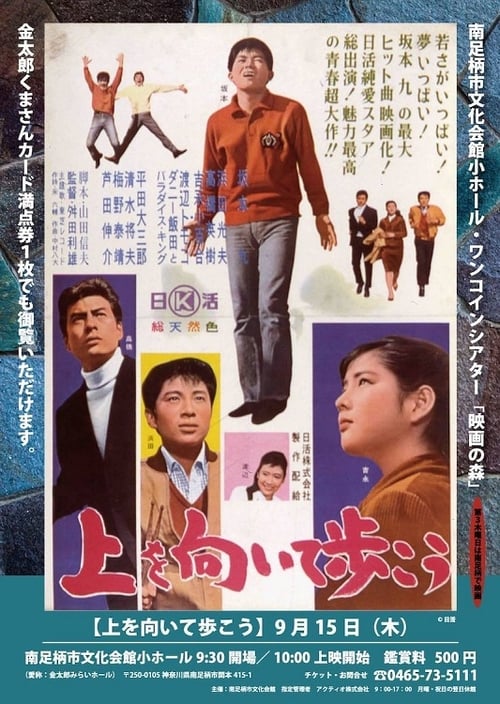
Keep Your Chin Up
Plot
Kawanishi Kyu and Tomoda Ryoji, two waifs, are inmates of a Reform School. One night, the boys succeed in a mass escape and split up. Kyu and Ryoji hear the sirens shrieking behind them and panic. Kyu pretends he has been hit by a small truck and Ryoji demands that they be taken to a hospital, little dreaming that Nagai, the driver, is the official guardian of juveniles. The next morning the two boys hear a light knock, and Nagai's daughter, Noriko enters, but surprise is changed to fear as they see her father approaching with Kume, the Juvenile Officer. Their one thought is escape but Kyu discovers his leg is stiff and it pains him to move. In the excitement, he had not realized he had really been hit by the truck. He sends Ryoji away while he waits alone for Officer Kume. Nagai takes Kyu under his wing, while Ryoji finds himself again in the hard-boiled world.
Get the Weekly Woke Watchlist
New and trending movies scored for woke bias, preachy messaging, and forced political themes — before you waste your evening.
No spam. One useful email per week.
Overall Series Review
Categorical Breakdown
The movie critiques social inequality and the unfair judgment of the boys based on their delinquent status, which is a critique of class and circumstance, not race or gender. The narrative focuses on the universal need for a compassionate adult and the merit of a good heart, as the protagonist Kyu is judged by the content of his character and is given shelter by a family.
The film criticizes the institutional failures of the juvenile system that labels the boys as 'delinquents' but does not frame Japanese society as fundamentally corrupt or evil. The ending includes a montage celebrating Japan's industrial growth and the spirit of anticipation for the 1964 Tokyo Olympics, which functions as a hopeful and grateful vision for the nation's future and a positive expression of home culture.
The core story is a drama of male youth and male mentorship with the kind officer Nagai taking the protagonist under his wing. The female role of Nagai's daughter, Noriko, is ancillary and appears to be a supportive family figure in a normative domestic structure. There is no presence of 'Girl Boss' tropes, emasculation of males, or anti-natalist messaging common to modern feminist narratives.
As a 1962 social drama, the movie operates entirely within a normative structure. The plot does not contain any themes related to alternative sexualities, queer theory, gender identity politics, or the deconstruction of the nuclear family as an institution.
The movie is a secular social drama focused on institutional reform and the personal character development of the youth. The narrative is void of any critique or hostility toward traditional religion, and morality is portrayed as an objective, transcendent good through the compassion and ethical responsibility displayed by the character Nagai.
Get the Weekly Woke Watchlist
New and trending movies scored for woke bias, preachy messaging, and forced political themes — before you waste your evening.
No spam. One useful email per week.