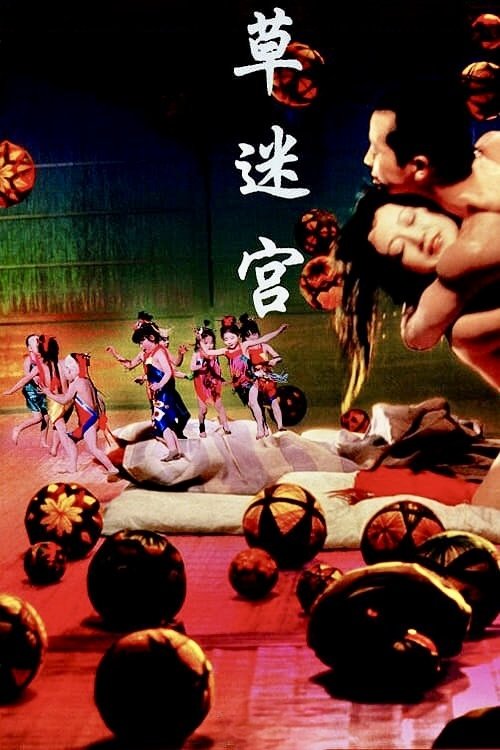
Grass Labyrinth
Plot
Akira is haunted by a "bouncing ball" song that he remembers his mother singing when he was a small child, and now on the verge of a sexually active adulthood, he wants to find the origins of the song. The young man ostensibly wanders into a time-warp in which aspects from his childhood and adulthood mix together. In this never-never land he comes across a beautiful woman/witch who is lost inside the labyrinth of her mansion, just as the young man is lost in the labyrinth of time — and on some levels, perhaps the labyrinth of his subconscious.
Get the Weekly Woke Watchlist
New and trending movies scored for woke bias, preachy messaging, and forced political themes — before you waste your evening.
No spam. One useful email per week.
Overall Series Review
Categorical Breakdown
The film is an entirely Japanese production with an all-Japanese cast, focusing on a deeply personal, Oedipal, and psychological journey. The narrative conflict is a private quest for lost memory and sexual identity, not a lecture on systemic oppression, race, or intersectional hierarchy. Character value is tied to their role in the protagonist’s subconscious drama, not their immutable characteristics.
The film is a product of the Japanese 'Angura' (underground/anti-establishment) artistic movement. Its critique is directed at conventional Japanese social structures and modern life through the use of twisted folklore and surreal, ritualistic imagery. The focus is on a psychological retreat into memory and the macabre, which functions as deconstruction of one's own immediate culture, but it does not engage in a hostility toward Western civilization or ancestors, as the definition requires for a high score.
The gender dynamic is defined by a Freudian Oedipal obsession, attraction, and sexual repression, with the primary female figures being archetypal—the distant mother, the witch/seductress, and the prostitute. The narrative is male-driven, focused on the protagonist’s sexual maturation. This presentation is hyper-sexualized and psychoanalytic, which runs counter to the modern 'Girl Boss' or anti-natalist tropes. Motherhood is a key, elusive psychological object, not framed as a 'prison' for the woman herself.
The core of the plot is an investigation into heterosexual male development and Oedipal desire, explicitly focusing on the mother-son relationship and attraction to female figures. While the film is highly erotic and sexual, it maintains a normative male-female structure in its archetypes. There is no presence of 'centering alternative sexualities,' deconstruction of the family unit via queer theory, or discussion of gender ideology.
As an avant-garde work, the film subverts and uses traditional or ritualistic elements, including a character who is a 'principal/priest/old man' and a troupe of 'demonic figures.' This suggests a general deconstruction of religious or societal authority common to anti-establishment art. However, the spiritual vacuum is a consequence of the protagonist's psychological break, and the primary target is not a specific traditional religion like Christianity, which is necessary for a high score in this category.
Get the Weekly Woke Watchlist
New and trending movies scored for woke bias, preachy messaging, and forced political themes — before you waste your evening.
No spam. One useful email per week.