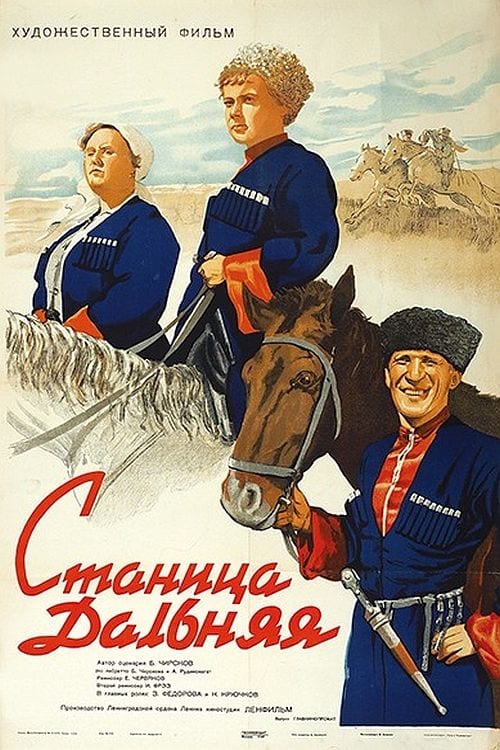
Станица Дальняя
Plot
Military maneuvers are being conducted in the Kuban villages of Dalnyaya and Kochevskaya, with the participation of village Cossack detachments. The Kochevskaya reconnaissance unit is led by the dashing Cossack Mikhail, while his fiancée Dasha Gorkunova is a communications officer for the "enemy" unit. Dasha cleverly deceives her "enemy" and, having escaped from her pursuers, gives instructions to "her own."
Get the Weekly Woke Watchlist
New and trending movies scored for woke bias, preachy messaging, and forced political themes — before you waste your evening.
No spam. One useful email per week.
Overall Series Review
Categorical Breakdown
The narrative rests on universal meritocracy within the Soviet framework, judging characters by their military skill and commitment to the collective farm, not on immutable characteristics or race. Casting reflects the local, culturally-specific Cossack setting without forced insertion of diversity or vilification of any specific ethnic group.
The film is overtly patriotic, celebrating the 'Soviet home'—specifically the collective farm and the Cossack traditions integrated into the new Soviet life. Core Soviet institutions (the military, the collective) are viewed as essential shields against chaos and are promoted with gratitude, which is the direct opposite of civilizational self-hatred.
Gender roles show a degree of fluidity and complementarity; the female lead, Dasha, is capable and clever, actively outsmarting the men. Women demonstrate competence by taking over the men's essential farm work and even capture a male military unit. However, the women initially struggle, preventing the 'perfect instantly' trope, and the narrative concludes by celebrating motherhood and traditional male-female pairing with a mass wedding, upholding a pro-family and vitalist structure.
The core of the plot is the traditional male-female pairing between Mikhail and Dasha, culminating in their wedding. The nuclear family structure is presented as the unquestioned and normative standard in the context of the final mass wedding. There is no presence of alternative sexual ideologies, deconstruction of the family unit, or lecturing on gender theory.
The film replaces traditional religion with the moral and ethical framework of the Soviet state (socialism, duty to the collective), promoting an objective, transcendent moral law defined by Communist ideology. Traditional faith is absent from the public narrative, creating a spiritual vacuum, but the absence of moral relativism and direct Christian villainy keeps the score low.
Get the Weekly Woke Watchlist
New and trending movies scored for woke bias, preachy messaging, and forced political themes — before you waste your evening.
No spam. One useful email per week.