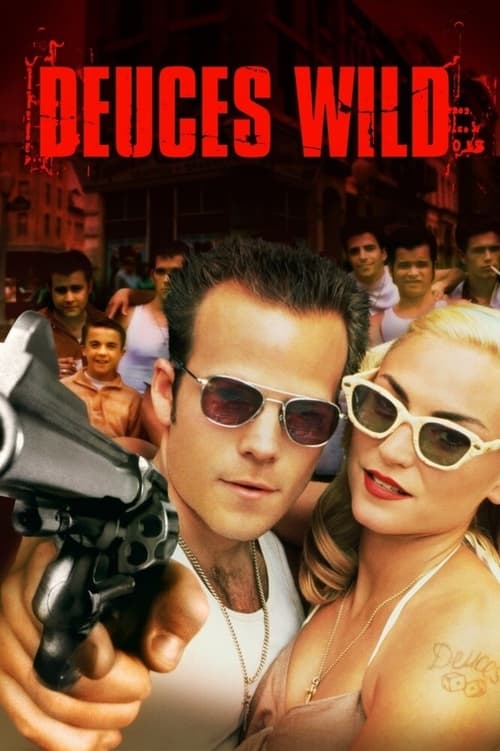
Deuces Wild
Plot
In 1950s New York City, a bad and bloody gang war is about to erupt on the dysfunctional streets of Brooklyn between the Deuces and the vicious Vipers.
Get the Weekly Woke Watchlist
New and trending movies scored for woke bias, preachy messaging, and forced political themes — before you waste your evening.
No spam. One useful email per week.
Overall Series Review
Categorical Breakdown
The narrative is entirely concerned with an intra-ethnic, working-class street gang conflict based on turf, loyalty, and a personal feud. Characters are judged by their actions and adherence to the gang’s code of honor, not by immutable characteristics or an intersectional hierarchy. The casting and setting are historically authentic to the specific Brooklyn neighborhood and time period depicted. There is no vilification of 'whiteness' or forced insertion of diversity; the focus is on a specific, homogenous sub-culture.
The film does not engage in civilizational self-hatred, but it presents a deeply dysfunctional local community. The young protagonists are often depicted as having a code of honor superior to the corrupt adults, but the final outcome suggests that the only way to find hope is to abandon the 'unbearable' neighborhood altogether. This is a rejection of the specific 'home' community and its institutions (family, law, church) as hopelessly corrupted, scoring moderately for localized self-hatred rather than broad Western critique.
Female characters are few and their roles are traditionally complementarian, defined by their relationships to the male gang members as mothers, sisters, or girlfriends. They are often victims of the male violence, such as the mother who becomes an alcoholic or the girlfriend who is brutally beaten. The film contains no 'Mary Sue' or 'Girl Boss' tropes and no explicit anti-natalist lecturing, with the women’s suffering being a consequence of the hyper-masculine world they inhabit.
The narrative is completely centered on a traditional male-female *Romeo and Juliet*-style romance that serves as a core plot device. The subject matter is hyper-masculine gang conflict. There is no inclusion of alternative sexualities, gender ideology, or deconstruction of the nuclear family. The film adheres to a normative sexual structure without any political commentary.
The local Catholic priest attempts to intervene to stop the violence, demonstrating a faith-based push for peace, but his pleas are ignored by the gang members. This portrays religious authority as weak and ineffective in the face of local chaos, but it does not frame the religion itself as a root of evil. The characters operate on a moral code of personal honor, revenge, and self-made justice, suggesting a pragmatic moral relativism has supplanted a transcendent moral law.
Get the Weekly Woke Watchlist
New and trending movies scored for woke bias, preachy messaging, and forced political themes — before you waste your evening.
No spam. One useful email per week.