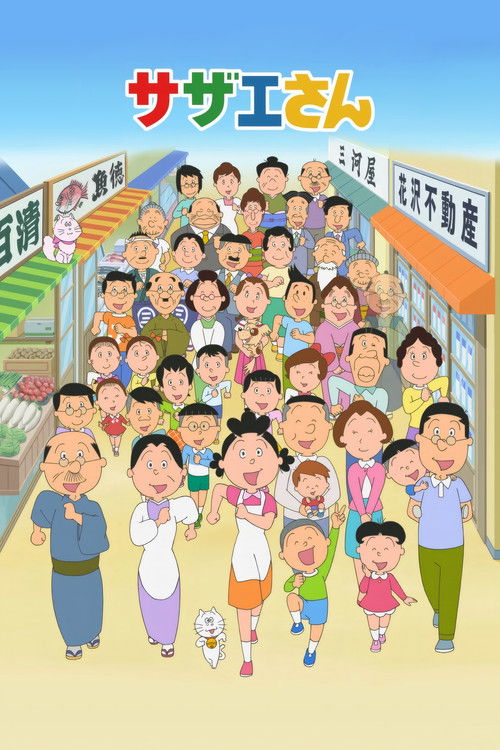
Sazae-san
Season 1 Analysis
Season Overview
No specific overview for this season.
Season Review
Categorical Breakdown
The focus is exclusively on an ethnically Japanese family and their domestic lives, rendering Western concepts of racial hierarchy, vilification of 'whiteness,' or forced diversity entirely irrelevant. Character motivations and plot conflicts rely on personality and family roles, adhering to a universal meritocracy of personal conduct.
The series functions as a profound cultural touchstone and a celebration of traditional Japanese daily life and customs. It provides a stable, idealized, and positive vision of the postwar Japanese community and a shared cultural identity, directly affirming institutions like the extended family.
Sazae is explicitly depicted as a 'very liberated woman' who frequently exerts dominance and authority over her husband, which was considered controversial in 1969 Japan. Early storylines included her affiliation with a 'women's lib group.' This pushes the score higher, as it includes the classic 'emasculated male' trope. However, the narrative is anchored by the celebration of her role as a mother and housewife within the extended family, preventing it from crossing into anti-natalist messaging.
The narrative is strictly focused on the normative structure of the traditional nuclear and extended family. Sexual identity is not a feature of the show, and the family dynamic is presented as the standard, wholesome structure without any critique or attempt to deconstruct the male-female pairing.
The series is a lighthearted, slice-of-life comedy focused on family values and appreciating the 'little things' in life. The narrative operates within an inherent, positive, and culturally-specific moral framework of respect and community, promoting objective moral conduct rather than moral relativism or hostility toward faith.