Equilibrium
Plot
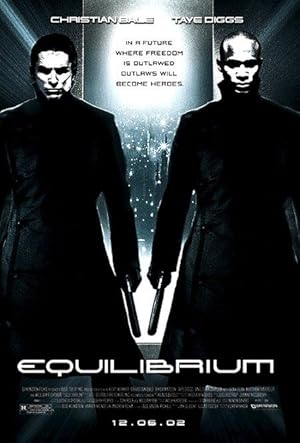
In a futuristic world, a strict regime has eliminated war by suppressing emotions: books, art and music are strictly forbidden and feeling is a crime punishable by death. Cleric John Preston (Bale) is a top ranking government agent responsible for destroying those who resist the rules. When he misses a dose of Prozium, a mind-altering drug that hinders emotion, Preston, who has been trained to enforce the strict laws of the new regime, suddenly becomes the only person capable of overthrowing it.
Get the Weekly Woke Watchlist
New and trending movies scored for woke bias, preachy messaging, and forced political themes — before you waste your evening.
No spam. One useful email per week.
Overall Series Review
Categorical Breakdown
The movie operates on a purely universalist framework where characters are defined by one axis: whether they feel emotions or repress them through the state-mandated drug, Prozium. The protagonist's transformation is based entirely on his rediscovery of his own soul, not on his race or any immutable characteristics. Casting is naturally colorblind without any explicit political commentary or focus on intersectional hierarchy. Character merit is the sole measure of effectiveness, either as a Cleric or a Resistance fighter.
The film's critique is aimed entirely at the totalitarian, emotion-suppressing government of Libria. This regime is actively hostile to all forms of art, literature, and music—the cultural heritage of its ancestors. The protagonists fight to restore the core Western and universal human values of individual liberty, free expression, and the importance of the human spirit. The narrative frames core human institutions and cultural vitality as necessary shields against the chaos of state-enforced conformity.
Gender roles are largely traditional within the narrative. The main female character in the resistance is supportive of the male lead's emotional awakening and is not portrayed as a 'Girl Boss' figure in the sense of instant, unearned perfection. The destruction of the protagonist's traditional family unit (his wife's execution) is a catalyst for his defection, underscoring the value of love and family that the oppressive regime sought to eliminate. There is no anti-natalist messaging; the protagonists are fighting for the right to feel love for their children.
The narrative's central theme is the suppression and subsequent reawakening of fundamental human emotions, including love, joy, and grief. Sexual identity politics are entirely absent from the plot, which focuses on the emotional capacity of all people regardless of pairing. The nuclear family structure (Preston, his wife, and children) is referenced as a casualty of the state's oppression, representing a normative structure that the resistance is ultimately fighting to save and restore.
The oppressive state uses co-opted religious terminology (the leader is 'Father,' the enforcers are 'Clerics') to mask a purely secular, authoritarian, and mechanical control system. The regime is not a traditional religious order but a police state that forces drug-induced emotional apathy. The core spiritual crisis is the loss of the human soul and the pursuit of transcendence through art and feeling. The movie's moral argument defends Objective Truth—that human emotion is intrinsically good—against the state's moral relativism, which deems emotion 'evil' only to justify its power.
Get the Weekly Woke Watchlist
New and trending movies scored for woke bias, preachy messaging, and forced political themes — before you waste your evening.
No spam. One useful email per week.