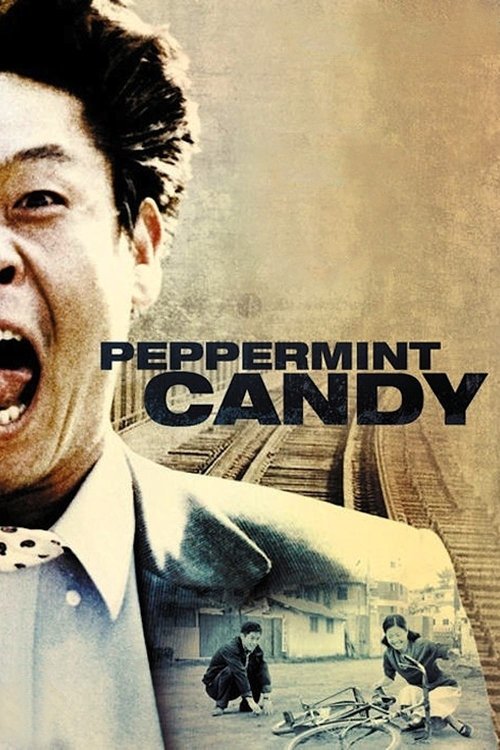
Peppermint Candy
Plot
In the spring of 1999, a group of old friends gather to celebrate their 20 year reunion. Among the group is Yeong-ho, a cold, unhappy man, whose demeanor puts a damper on the festivities. The seriousness of Yeong-ho's depression becomes apparent when he climbs a railroad bridge and looks like he might jump. At this crucial moment, memories of seven crucial episodes from Yeong-ho's past flood his mind.
Get the Weekly Woke Watchlist
New and trending movies scored for woke bias, preachy messaging, and forced political themes — before you waste your evening.
No spam. One useful email per week.
Overall Series Review
Categorical Breakdown
The plot structure is fundamentally based on exposing the devastating effects of systemic oppression, which, in this context, is the oppressive political apparatus of the South Korean military dictatorship and its instruments. The narrative focuses on power dynamics where the system corrupts the male protagonist, turning him into an oppressor (a sadistic policeman who tortures a student activist) and a toxic individual. This functions as a political/class critique that lectures on systemic oppression and the vilification of those in the power structure.
The film's core purpose is a deep and explicit critique of the national heritage and civilizational trajectory of South Korea. The narrative frames the country's recent history, including military rule and rapid economic expansion, as fundamentally corrupting and destructive to the Korean soul. The protagonist's moral decay is explicitly used as a national metaphor, showing profound hostility toward the institutions and sacrifices that led to the 'modern' state.
The male protagonist’s profound descent into depravity directly involves the mistreatment of women, including being a toxic and abusive husband who objectifies his wife. The man is clearly depicted as toxic, and his wife is portrayed as a victim of his moral failure and resulting abuse/neglect. The female characters are not 'Girl Boss' or 'Mary Sue' figures. The destruction of the family unit is framed as a tragedy caused by the man’s moral decay, not a celebration of anti-natalism by the woman.
The film is a straight, historical drama focused entirely on a heterosexual man, his first love, and his wife, spanning two decades of South Korean history. There is no inclusion of alternative sexualities, deconstruction of the nuclear family through queer theory, or discussion of gender ideology. Sexuality is treated as a private matter in the context of traditional male-female pairing.
There is no overt hostility toward religion. The film is a moral and political tragedy centered on themes of conscience, guilt, and the lamentation of a lost soul, which is an existential, moral investigation. The spiritual vacuum is a result of state violence and personal moral failure, not a direct critique of faith. The narrative operates on a clear sense of objective moral failure (torture, abuse), running counter to subjective moral relativism.
Get the Weekly Woke Watchlist
New and trending movies scored for woke bias, preachy messaging, and forced political themes — before you waste your evening.
No spam. One useful email per week.