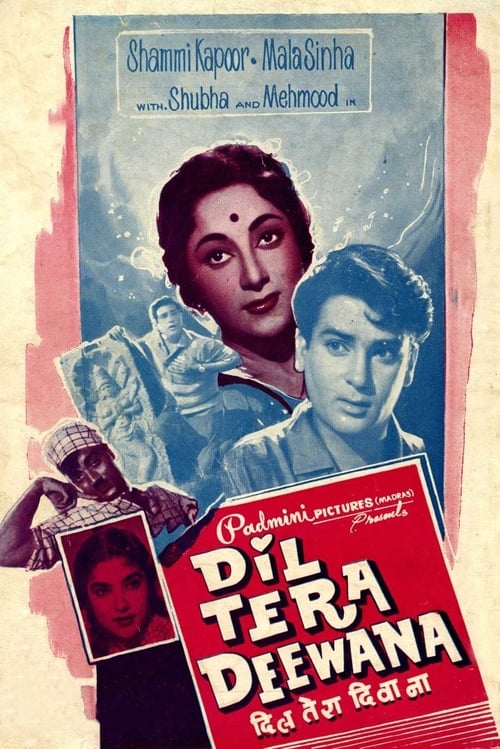
Dil Tera Diwana
Plot
Wayward, brash, and disobedient Mohan (Shammi Kapoor) is sent by his angry dad Diwan Badriprasad (Ulhas) to a retired army captain Dayaram (Om Prakash) to learn some discipline and respect. But Mohan asks his friend Anokhe (Mehmood) to switch places with him, and Anokhe agrees to do so. Mohan meets with Meena (Mala Sinha), who lives with her blind dad (Manmohan Krishan). Anokhe is welcomed as Mohan by Captain Dayaram and his daughter Malti (Shubha Khote) in their household. Eventually both Malti and Anokhe fall in love. Things start to get even more muddled when Captain Dayaram finds out that Anokhe is married to another woman, and that Anokhe drives a rickshaw. The police are notified and they are asked to arrest Mohan - they arrest 3 Mohans. Who is the real Mohan?
Get the Weekly Woke Watchlist
New and trending movies scored for woke bias, preachy messaging, and forced political themes — before you waste your evening.
No spam. One useful email per week.
Overall Series Review
Categorical Breakdown
The narrative focuses on the internal character flaws of the protagonist, Mohan, who is judged as 'wayward' by his father, Diwan Badriprasad. The central theme involves a wealthy man falling in love with a poor woman, Meena, which suggests that love and character merit transcend class divisions. Race or immutable characteristics are not a basis for conflict or judgment; the focus remains strictly on personal behavior and character.
The plot's catalyst is the father's attempt to instill 'discipline and respect' in his son by sending him to a retired army captain, Captain Dayaram. This structure frames institutions like the traditional family unit and military discipline as positive forces for moral correction. The film shows respect for the sacrifices and experience of ancestors and elder figures, such as Dayaram, with no indication of civilizational self-hatred or demonization of heritage.
The female characters, Meena and Malti, are presented as moral and supportive figures within a traditional framework. Meena cares for her blind father, and both women are the object of a standard, romantic, male-led pursuit. There is no presence of the 'Girl Boss' trope, anti-natalism, or any attempt to emasculate the male characters; traditional gender roles are assumed and complementarianism is the operating principle.
The story is solely concerned with two traditional male-female romantic pairings (Mohan/Meena and Anokhe/Malti). The narrative operates entirely within a normative structure, centering the nuclear family and traditional courtship. The film contains no overt or implied exploration of alternative sexualities or gender ideology.
The morality of the film is objective, valuing virtues like honesty, respect, and discipline, which are framed as universal goods necessary for good character. There are no religious characters presented as villains or bigots, and the plot does not engage in deconstruction or hostility toward faith, operating instead on a secular level of universal, transcendent moral law.
Get the Weekly Woke Watchlist
New and trending movies scored for woke bias, preachy messaging, and forced political themes — before you waste your evening.
No spam. One useful email per week.