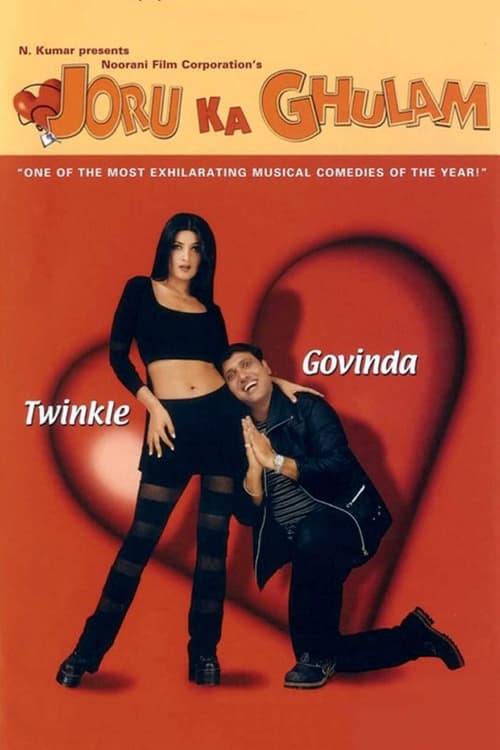
Joru ka Ghulam
Plot
Dhaneshwar Pitamber, has four daughters. All the four daughters are not ready to marry, each one having their own reason. The daughters always play mischievous tricks on the one coming with a proposal of marriage, and their gang leader is the youngest daughter Durga. Kader Khan is so desperate to get his daughters married that he is ready to give a dowry of five crores to each son-in-law. Raja and Kanahaiya are small time con men at the airport. Raju Patel is an NRI from America who comes to India to get married to one of the daughters of Dhaneshwar.
Get the Weekly Woke Watchlist
New and trending movies scored for woke bias, preachy messaging, and forced political themes — before you waste your evening.
No spam. One useful email per week.
Overall Series Review
Categorical Breakdown
The casting is historically and culturally authentic for a Hindi film set in India. The main conflict revolves around wealth, honesty, and a conman’s redemption, focusing on character merit rather than race or immutable characteristics. Class differences are present but serve a traditional comedic purpose, not a lecture on systemic hierarchy.
The film’s setting is entirely within a wealthy Indian home, and the conflict centers on the successful continuation of the central Indian institution of the family and marriage. The protagonist's moral arc involves him giving up a life of crime to embrace an honest domestic life. No part of the narrative attempts to deconstruct or demonize Indian heritage, ancestors, or home culture.
The initial premise features four women actively and successfully rejecting the institution of marriage, with the female lead acting as the 'gang leader,' which gives them temporary agency. However, the entire main plot is structured as a 'taming of the shrew' story, where the male lead's eventual success is defined by convincing the female lead to accept marriage and domesticity. The final resolution is the marriage of all four sisters, which strongly celebrates the traditional, complementary male-female pairing and family formation.
The plot focuses exclusively on the goal of arranging heterosexual marriages and establishing the nuclear family structure. Alternative sexualities, gender identity issues, or critiques of the traditional family are entirely absent from the narrative. Sexuality is not a public political issue, and the structure is completely normative.
The core moral arc involves the male protagonist, a conman, reforming his dishonest ways to become an honest man and husband. This narrative trajectory implicitly upholds an objective moral law and a higher moral order (honesty over theft). The movie is a light-hearted comedy and contains no hostility toward religion or promotion of moral relativism.
Get the Weekly Woke Watchlist
New and trending movies scored for woke bias, preachy messaging, and forced political themes — before you waste your evening.
No spam. One useful email per week.