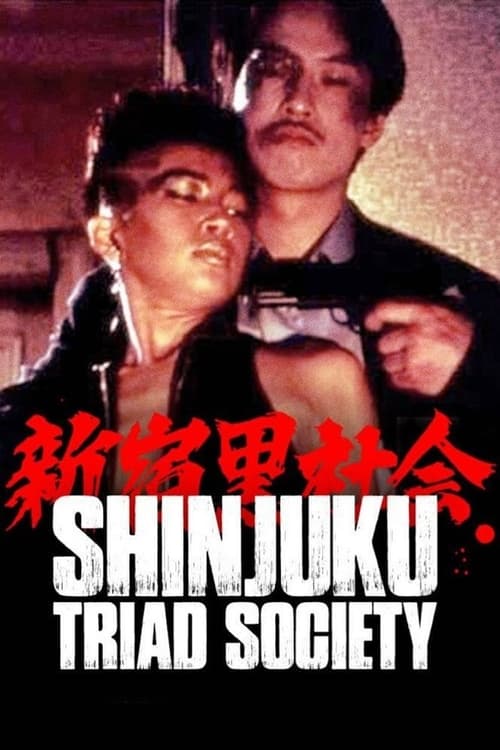
Shinjuku Triad Society
Plot
Tatsuhito, a cop, pursues Chinese warlord Wang through the underworld of Shinjuku and over to Taiwan.
Get the Weekly Woke Watchlist
New and trending movies scored for woke bias, preachy messaging, and forced political themes — before you waste your evening.
No spam. One useful email per week.
Overall Series Review
Categorical Breakdown
The narrative is fundamentally structured around ethnic tension, with the protagonist being a mixed-race (half-Chinese, half-Japanese) cop who is an outsider in his own society, pursuing a Taiwanese gangster. The core conflict is a turf war between Taiwanese Triads and the Japanese Yakuza, explicitly foregrounding 'race' and 'ethnic tensions' as a defining characteristic of the characters and the plot. The plot functions to explore the prejudices against 'outsiders born of different heritages' in Japan.
The film explicitly frames its local culture's institutions as fundamentally corrupt and evil. The police force is depicted as 'uncaring and uncontrollable,' with the cop protagonist Kiriya being an abusive and morally bankrupt figure who uses sexual assault as an interrogation technique. This paints the 'home' system as fundamentally broken and morally equivalent to the criminal element, embracing a dark, corrosive nihilism toward the civilizational structure.
The film does not contain 'Girl Boss' or 'Mary Sue' tropes. Instead, it is highly misogynistic, featuring graphic violence, abuse, and sexual assault against female characters. One female character who is a victim of sodomy by the protagonist is later shown to be enamored with him and aids his escape, a depiction that is the inverse of anti-male feminist messaging.
The main antagonist is clearly defined as a 'gay Taiwanese gangster.' The film includes multiple explicit and transgressive homosexual acts, including non-consensual male-on-male sexual assault used as an interrogation method. Sexual identity is centered as a key attribute of a major character, but this is done within a nihilistic crime context rather than as a positive political lecture or a vehicle for gender ideology.
The core thematic foundation is 'dark corrosive nihilism.' The film 'paints a grey world where good and evil simply don't exist,' focusing entirely on 'desperate survival and unkempt desire.' This atmosphere embraces an absolute moral relativism, functioning as a complete spiritual vacuum where no transcendent or higher moral law is acknowledged.
Get the Weekly Woke Watchlist
New and trending movies scored for woke bias, preachy messaging, and forced political themes — before you waste your evening.
No spam. One useful email per week.