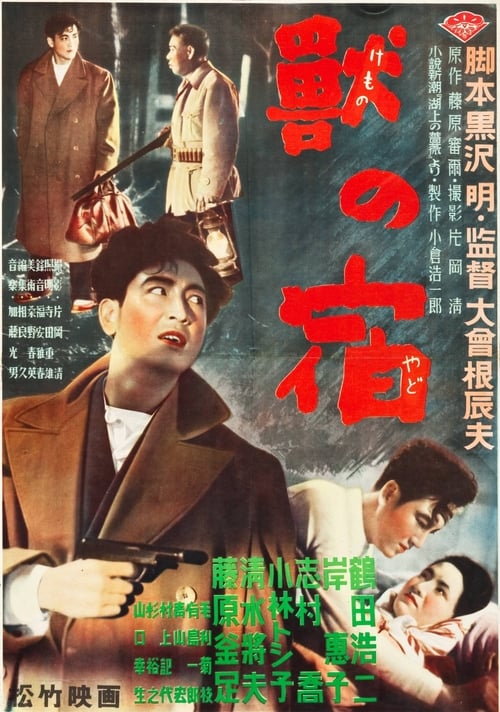
The Den of Beasts
Plot
Get the Weekly Woke Watchlist
New and trending movies scored for woke bias, preachy messaging, and forced political themes — before you waste your evening.
No spam. One useful email per week.
Overall Series Review
Categorical Breakdown
The film is a 1951 Japanese production; the criteria for 'vilification of whiteness' and 'forced diversity' are not applicable to the setting. Character conflict centers on the code of the *yakuza* and individual merit or betrayal, not intersectional hierarchy or immutable characteristics. Casting is culturally authentic to post-war Japan.
The film is a Japanese crime drama and does not engage in 'hostility toward Western civilization.' While it may critique corruption or decay within the criminal underworld or aspects of post-war Japanese society, this is specific social commentary, not an attack on the core of Japanese national identity, ancestors, or fundamental institutions.
The female characters, common in *yakuza* films, are often supporting roles, such as the loyal moll or the tragic figure caught in the criminal world. Their strength is a reaction to a harsh reality, which is distinct from the modern 'Girl Boss' trope. Gender dynamics reflect the 1950s setting, which is a conservative culture focused on distinct, though not necessarily celebrated, male and female roles. The slight increase from 1 acknowledges the likely presence of women as victims or love interests in a primarily male-focused crime narrative, but there is no anti-natalism or perfect, unearned female competence.
The 1951 Japanese context and the *yakuza* genre contain no focus on 'sexual ideology,' 'queer theory,' or 'deconstructing the nuclear family.' Sexuality is either private or traditional, and the narrative does not center alternative sexualities as an identity or political theme.
The film is set in Japan, where the dominant spiritual traditions are Shinto and Buddhism. The narrative focuses on the moral codes of the criminal world and universal human vices, not hostility toward Christianity or its doctrines. The film deals with issues of right and wrong within a criminal structure, which can be cynical but does not constitute an ideological attack on transcendent morality.
Get the Weekly Woke Watchlist
New and trending movies scored for woke bias, preachy messaging, and forced political themes — before you waste your evening.
No spam. One useful email per week.