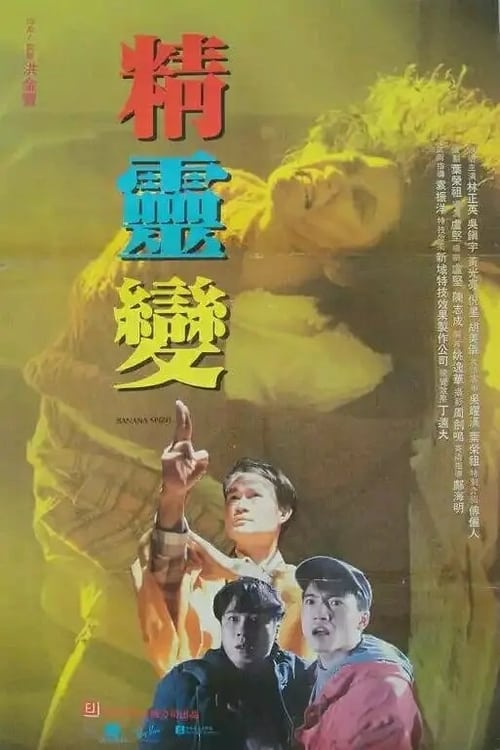
Banana Spirit
Plot
Francis Ng stars as Chic, who helps his friend Che, a Taoist ghostbuster, with various assignments. They both owe gambling debts to the nasty mobster Rabid Hsiung, so they're in desperate need of money, leading them to take on a request from the elderly Taoist master Tang to help him capture the Banana Spirit. On a late-night search, the trio is frightened by a demon as well as awakening the Banana Spirit, Muyung Yu-Yu, who takes the earthly form of a beautiful model and seduces Chic. Chic and the ghost become lovers, and she saves his life when he is shot at by mobsters as well as helping him win a great deal of money at one of Rabid Hsiung's casinos. Hsiung figures out that Yu-Yu has special powers, which he attempts to use for his own benefit, but Chic kills him before he can realize his plans. Unfortunately, Hsiung rises from the grave as a clownish evil spirit looking for revenge, and Yu-Yu's allotted time on Earth is quickly running out.
Get the Weekly Woke Watchlist
New and trending movies scored for woke bias, preachy messaging, and forced political themes — before you waste your evening.
No spam. One useful email per week.
Overall Series Review
Categorical Breakdown
The movie is a Hong Kong production featuring an entirely East Asian cast dealing with local folklore and crime. Character motivations are based on personal debt and supernatural necessity. There is no element of 'whiteness' vilification, forced diversity, or race-swapping. The narrative is entirely self-contained within its cultural and genre context.
The plot centers on a Taoist ghostbuster and an elderly Taoist master working with traditional spiritual practices and folklore (the Banana Spirit legend). This engagement with and utilization of Chinese/Southeast Asian spiritual and cultural heritage shows respect for the ancestors' traditions. The institutions of the spiritual world are portrayed as functional forces against chaos and evil.
The Banana Spirit, Muyung Yu-Yu, is a powerful supernatural entity who actively seduces the male lead, saves his life, and controls the flow of wealth, making her far from a passive character. She possesses immense power and agency within the plot, rising above a simple complementary role. However, the core dynamic remains a traditional male-female romantic relationship, and the film does not feature anti-natalist messaging or gender-based political lectures.
The primary romantic relationship driving the plot is a passionate one between the male protagonist, Chic, and the female ghost, Muyung Yu-Yu. The film maintains a normative structure focused on this supernatural but heterosexual pairing. No presence of centering alternative sexualities, deconstructing the nuclear family, or lecturing on gender ideology is evident.
Taoism is central to the heroic side of the narrative, with a Taoist master and a Taoist ghostbuster being key figures whose spiritual knowledge is required to confront the supernatural threats. Traditional Eastern faith and practice are presented as a source of strength. The primary antagonist is a mobster who returns as an evil spirit, not a religious figure, and there is no overt critique of traditional religion or espousal of moral relativism.
Get the Weekly Woke Watchlist
New and trending movies scored for woke bias, preachy messaging, and forced political themes — before you waste your evening.
No spam. One useful email per week.