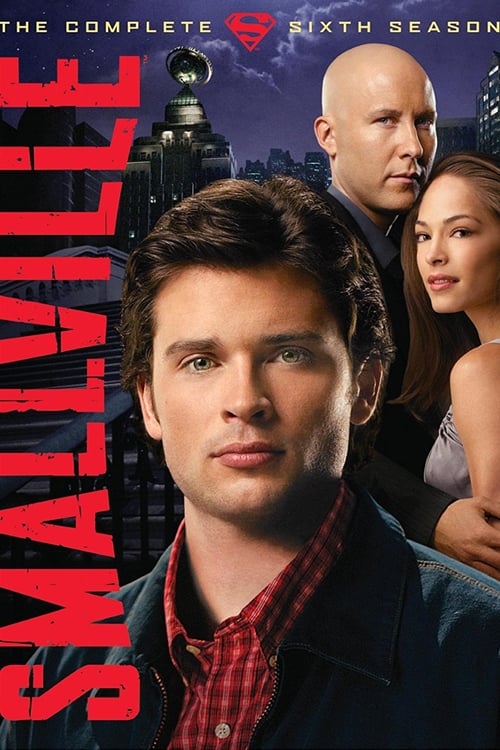
Smallville
Season 6 Analysis
Season Overview
Clark manages to escape from the Phantom Zone with the help of an unexpected ally. He subsequently sets out on a mission to hunt down the dangerous prisoners who followed him to Earth. Adding to Clark's troubles, there is a new vigilante in town who goes by the name Green Arrow. Meanwhile, Lex and Lana take the next step in their relationship. As the season progresses, the rivalry between Clark Kent and Lex Luthor will explode into a fierce good-versus-evil battle.
Season Review
Categorical Breakdown
The narrative foundation rests on the intrinsic good of Clark Kent against the corruption of Lex Luthor. Character is judged by the content of their soul and choices, exemplified by Oliver Queen (a privileged male) choosing heroism and Lex (a privileged male) choosing evil. Diversity in the main cast is limited, and the introduction of Martian Manhunter, an alien, does not involve a lecture on Earth-bound intersectional hierarchy.
The series is grounded in the moral rectitude of the Kent farm and small-town Kansas values. Clark's human adoptive parents are the source of his goodness, providing a shield of virtue against the chaos of Lex Luthor's corporate Metropolis. Krypton is depicted as a superior but self-destroyed civilization, with its remnants (Jor-El's AI) trying to guide the hero to save Earth, not condemn Western civilization.
Female leads like Lois Lane and Chloe Sullivan are highly intelligent, competent, and driven, demonstrating professional success without emasculating the hero. The central drama involves the villain Lex Luthor faking a pregnancy to manipulate Lana into marriage, an act of patriarchal control that is framed as monstrous. Lana's arc culminates in her gaining independence, beating Lex at his own game, and leaving the marriage, which champions self-reliance over a traditional female role, pushing the score higher than pure complementarianism.
The core relationships follow a normative structure, centering on traditional male-female pairings (Clark and Lois/Lana, Chloe and Jimmy, Lois and Oliver). The show contains no overt centering of alternative sexualities, no explicit focus on sexual identity as a primary trait, and no engagement with gender ideology. The nuclear family (The Kents) is the moral ideal.
The show is built on pervasive Judeo-Christian mythological parallels, with Clark Kent's journey often functioning as a Christ-like allegory of destiny, self-sacrifice, and moral guidance. The central conflict between Clark and Lex is a clear battle between Transcendent Morality and subjective, self-serving power. Faith in a higher purpose (even Jor-El’s alien directive) is a source of strength.