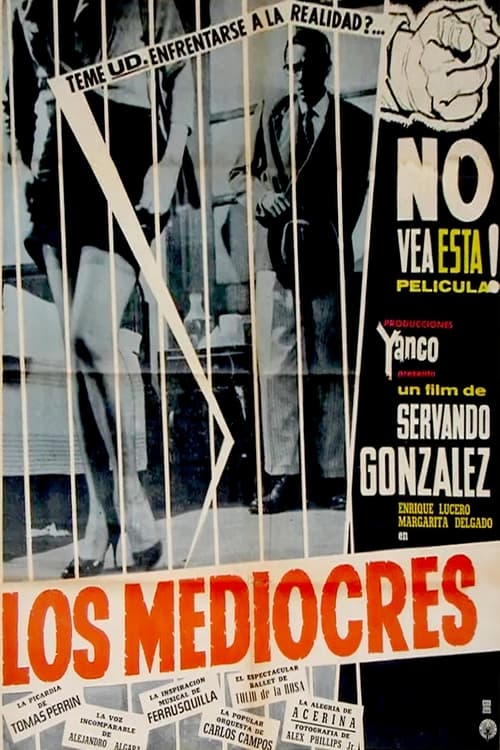
Los mediocres
Plot
Get the Weekly Woke Watchlist
New and trending movies scored for woke bias, preachy messaging, and forced political themes — before you waste your evening.
No spam. One useful email per week.
Overall Series Review
Categorical Breakdown
Characters are judged by their class privilege and its resulting lack of merit or social utility; the film’s central critique is a class distinction, not an intersectional hierarchy based on race or identity. The narrative focuses on the failures of a privileged elite regardless of their specific immutable characteristics, which aligns with universal meritocracy principles. There is no evidence of vilification of 'whiteness' or forced diversity, as the critique is directed at economic and social class.
The film criticizes the elite class for their cultural self-alienation, specifically their tendency to adopt 'Frenchified' customs and ignore local 'Mexican themes' and problems. This is an internal critique designed to promote national authenticity and focus on native issues, viewing local institutions and culture as the solution rather than condemning them as fundamentally corrupt. It views core cultural institutions as a bulwark against foreign cultural pretension.
The core plot is focused on social class and national critique, not gender dynamics. There is no evidence in the film's premise of 'Mary Sue' or 'Girl Boss' tropes, or an overt anti-natalist message. Masculinity is not a central subject of ridicule. The score reflects a non-focus on modern gender ideology and the constraints of its 1966 Mexican production period.
The plot is centered on social class critique and satire. There is no focus on alternative sexualities, deconstructing the nuclear family, or advancing gender ideology. The structure remains firmly within the normative social and private sexual framework typical of the era.
The film’s satire is directed toward the cultural and social irresponsibility of the upper class, not toward religious institutions or faith. There is no evidence of traditional religion being framed as the root of evil or of Christian characters being depicted as inherent bigots. The moral framework stems from an objective social critique of utility and responsibility.
Get the Weekly Woke Watchlist
New and trending movies scored for woke bias, preachy messaging, and forced political themes — before you waste your evening.
No spam. One useful email per week.