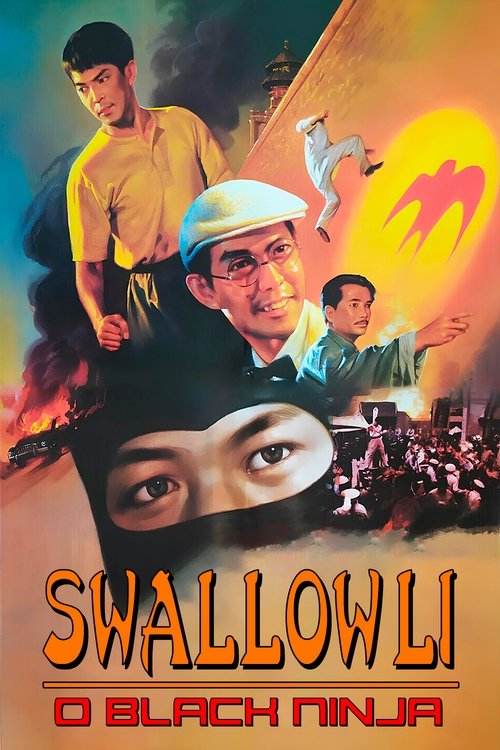
The Hero of Swallow
Plot
The 'flying Swallow', Li San (Yuen Biao) robs the rich to help the poor. He has come to Beijing to search for his lost love, Ching Li / Chinny (Athena Chu Yin), who has been sold as prostitute.
Get the Weekly Woke Watchlist
New and trending movies scored for woke bias, preachy messaging, and forced political themes — before you waste your evening.
No spam. One useful email per week.
Overall Series Review
Categorical Breakdown
The central conflict is economic (rich versus poor) and nationalistic (Chinese hero against corrupt officials and Japanese invaders), not focused on immutable characteristics or intersectional hierarchy. The hero's status is earned through his skill and moral code, promoting a meritocracy. The cast is culturally authentic to the pre-WWII China setting.
The movie is a Chinese-produced martial arts film that celebrates a Chinese folk hero. The narrative criticizes internal corruption (aristocrats, local police) and external threats (the Japanese), a classic theme of national defense and internal reform. It contains no hostility toward Western civilization, its home, or ancestors.
The hero's core quest is driven by a protective, chivalric impulse: rescuing his true love from exploitation. The love interest is a victim, not a 'Girl Boss.' A female supporting character is a thief who dresses like a man for practical reasons—to avoid attention—rather than as an ideological statement on gender. Masculinity is protective and competent.
The primary relationship dynamic is the heterosexual, romantic bond between the male hero and the female love interest. The narrative centers on this traditional pairing and the hero’s mission to save her. There is no presence of sexual ideology, deconstruction of the nuclear family, or focus on alternative sexualities.
The story’s foundation is a transcendent moral code of justice—robbing the corrupt rich to help the poor—which operates on an objective moral truth. While not overtly religious, this moral clarity opposes a theme of subjective, relative morality. There is no depiction of religion, specifically Christianity, as a root of evil.
Get the Weekly Woke Watchlist
New and trending movies scored for woke bias, preachy messaging, and forced political themes — before you waste your evening.
No spam. One useful email per week.