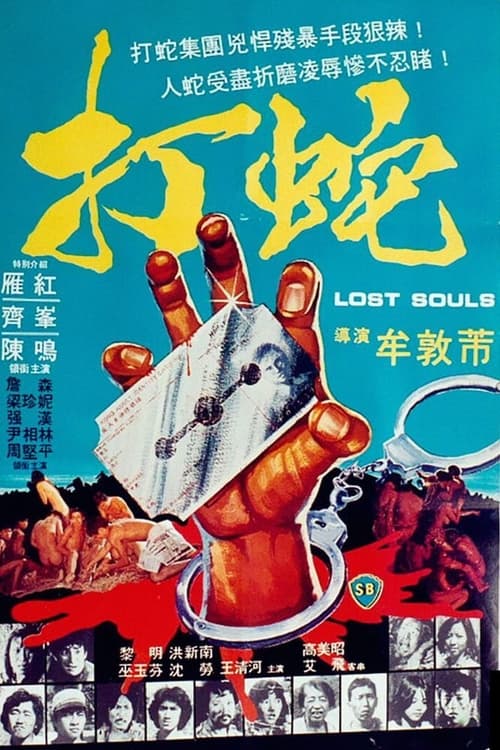
Lost Souls
Plot
Determined to escape from the harsh regime of China to the freedom of Hong Kong, three youths are captured by Mr. Hok, a sadistic human smuggler who subjects them to an unrelenting assault of degradation. Pushed to the limits of human endurance, the prisoners must fight for their lives in an unforgettable, action-packed climax.
Get the Weekly Woke Watchlist
New and trending movies scored for woke bias, preachy messaging, and forced political themes — before you waste your evening.
No spam. One useful email per week.
Overall Series Review
Categorical Breakdown
The plot centers on an intra-cultural conflict involving mainland Chinese victims and a Chinese criminal syndicate in Hong Kong. The conflict is a fight against criminal exploitation, not a lecture on systemic Western privilege or the vilification of whiteness. Character judgment is based on actions: survival and villainy, which aligns with universal meritocracy.
The narrative is driven by the desire to escape the 'harsh regime of China' for the perceived 'freedom of Hong Kong,' which frames the home country (China) as oppressive. However, the destination (Hong Kong) is also shown to harbor extreme, immediate evil in the form of the syndicate. The film criticizes a specific regime and social problem rather than broadly attacking the entire culture or Western civilization.
The film depicts the extreme degradation of both male and female captives, including rape and torture, with women being sold into prostitution. Women are portrayed as victims in an exploitation context, which is the inverse of the 'perfect Girl Boss' trope. There is no ideological message celebrating career over motherhood or systematic emasculation of men as a political statement; all victims are rendered powerless by the criminal gang.
The narrative's focus on sexual violence and degradation, which includes male and female victims, is solely within the context of criminal sadism and human trafficking. The film does not center alternative sexualities, deconstruct the nuclear family as an institution, or lecture on gender theory. The structure is entirely focused on the private, criminal acts of the syndicate against the individual captives.
The plot is a raw, secular depiction of crime and survival. The conflict is purely human-against-human, with the smugglers representing objective evil and the captives fighting for objective good (their lives). There is no explicit presence of, or hostility toward, traditional religion (specifically Christianity) to drive the plot or character motivations.
Get the Weekly Woke Watchlist
New and trending movies scored for woke bias, preachy messaging, and forced political themes — before you waste your evening.
No spam. One useful email per week.