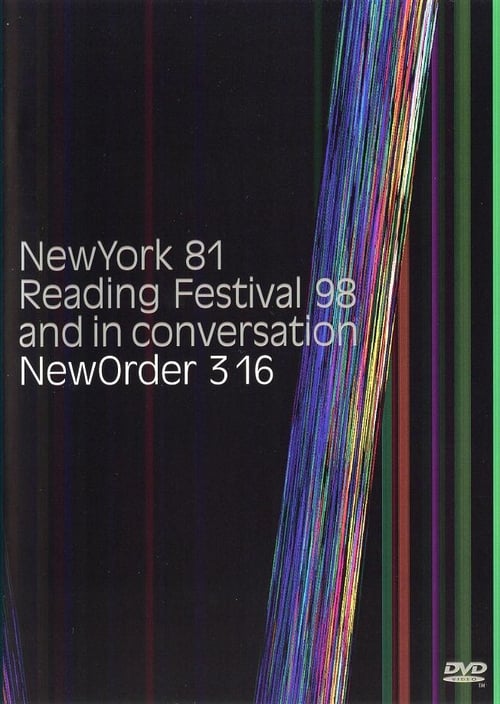
New Order 3 16
Plot
This isn't a documentary, but two completely separate concerts performed by the legends. The first finds them in 1981 playing New York. It's fascinating to see, because they still have that Joy Division image hanging over them. Brilliantly, they don't speak to the audience, or themselves. Heavily relies on the 'Movement' album, but has a proto Temptation, which is always good to hear. The second is their appearance at the 1998 Reading Festival, which is basically a greatest hits set, but there's nothing better than a New Order greatest hits: Regret, Bizarre Love Triangle, True Faith, Temptation (again!) and, of course, Blue Monday. The Joy Division back catalogue is also given a dusting down: Isolation, Atmosphere, Heart and Soul. Then there is an interview with the original four (we miss you Gillian) which reveals them completely at ease with their legend. God bless them.
Get the Weekly Woke Watchlist
New and trending movies scored for woke bias, preachy messaging, and forced political themes — before you waste your evening.
No spam. One useful email per week.
Overall Series Review
Categorical Breakdown
The film is a documentary-style record of live musical performances and a band interview. Character judgment is solely based on musical skill and professional history. The narrative does not engage in identity politics, intersectional hierarchy, or the vilification of any immutable characteristic. Casting is the natural, historically authentic lineup of the English rock band.
The media is a celebratory retrospective of a core Western cultural product: a successful British rock band. The content is positive and focuses on the band's musical evolution and legacy. There is no expression of hostility toward Western civilization, its institutions, or ancestors. The band members are shown to be proud and comfortable with their own history and legend.
The band includes a female member, Gillian Gilbert, who is shown simply as a vital, respected musician. The interview segment includes the line 'we miss you Gillian,' which relates to her absence, and her past decision to prioritize family life over touring is a publicly known fact not criticized within the film’s context. No characters are depicted as perfect 'Girl Bosses' or as emasculated, bumbling male figures. The media celebrates the creative unity and vitality of the band.
The content consists only of live music and a short conversation among band members. There is a complete absence of sexual ideology, the centering of alternative sexualities, or any deconstruction of the nuclear family concept. The structure adheres to the normative framework by simply being a documentary about the professional careers of four musicians.
The subject matter is music and the band's career history, containing no critique or hostility toward religion, specifically Christianity. Morality is not debated or framed as subjective 'power dynamics.' The user-provided summary even concludes with the positive expression 'God bless them,' affirming a lack of spiritual vacuum or anti-theistic messaging.
Get the Weekly Woke Watchlist
New and trending movies scored for woke bias, preachy messaging, and forced political themes — before you waste your evening.
No spam. One useful email per week.